Advertisements
Advertisements
प्रश्न
Find the odd one out and give its explanation.
विकल्प
Simple microscope
Compound microscope
Telescope
Prism
Advertisements
उत्तर
Prism
Explanation-
Prism disperses light while other optical instruments produce magnified images of objects.
APPEARS IN
संबंधित प्रश्न
A student is using a convex lens of focal length 18 cm to study the image formation by it for the various positions of the object. He observes that when he places the object at 27 cm, the location of the image is at 54 cm on the other side of the lens. Identify from the following diagram the three rays that are obeying the laws of refraction and may be used to draw the corresponding ray diagram.

(A) 1, 2 and 4
(B) 1, 3 and 5
(C) 2, 4 and 5
(D) 2, 3 and 4
An object of height 4.0 cm is placed at a distance of 30 cm from the optical centre 'O' of a convex lens of focal length 20 cm. Draw a ray diagram to find the position and size of the image formed. Mark optical centre 'O' and principal focus 'F' on the diagram. Also find the approximate ratio of size of the image to the size of the object.
If an object is at a considerable distance (or infinity) in front of a convex lens, where is the image formed?
List some things that convex lens and concave mirror have in common.
A convex lens of focal length 0.10 m is used to form a magnified image of an object of height 5 mm placed at a distance of 0.08 m from the lens. Calculate the position, nature and size of the image.
How would a pencil look like if you saw it through a convex lens? (Assume the pencil is close to the lens). Is the image real or virtual?
Draw a diagram to represent the second focus of a convex lens.
Study the diagram below.
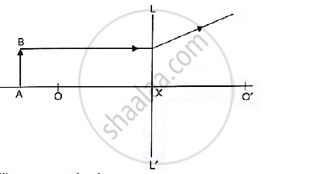
what are the points O, O’ called?
A convex lens forms an image of an object equal to the size of the object. Draw a diagram to illustrate it.
Complete the following table:
| Type of lens | Position of object | Nature of image | Size of image |
| Convex | Between optical centre and focus | ||
| Convex | At focus | ||
| Concave | At infinity | ||
| Concave | At any distance |
A convex lens has a divergent action and a concave lens has a convergent action.
A student places a 8.0 cm tall object perpendicular to the principal axis of a convex lens of focal length 20 cm. The distance of the object from the lens is 30 cm. He obtains a sharp image of the object on a screen placed on the other side of the lens. What will be the nature (inverted, erect, magnified, diminished) of the image he obtains on a screen? Draw ray diagram to justify your answer.
If an object is placed in front of a convex lens beyond 2F1, then what will be the position, relative size, and nature of an image which is formed? Explain with a ray diagram.
What is the difference between a double convex and a bi-convex lens?
What happens to the image formed by a convex lens if its lower part is blackened?
Which lens can produce a real and inverted image of an object?
Observe the given figure and answer the following questions.
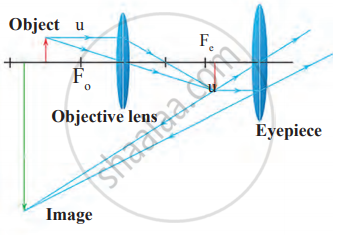
- Where is the above type of lens construction used?
- What type of image is formed by an objective lens?
- What happens instead of placing at Fo if the object is placed in between O and Fo?
Distinguish between:
Concave lens and Convex lens
