Advertisements
Advertisements
प्रश्न
Observe the given figure and answer the following questions.
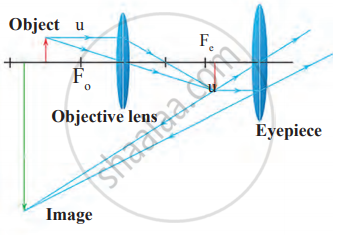
- Where is the above type of lens construction used?
- What type of image is formed by an objective lens?
- What happens instead of placing at Fo if the object is placed in between O and Fo?
Advertisements
उत्तर
- The above type of lens construction is used in a compound microscope.
- The image formed by the objective is real, inverted, and formed at a distance within the focal length of the eyepiece.
- If the object is placed in between O and Fo, a virtual image will be formed on the same side of the objective as that of the object. As a result, compound microscope will not be able to operate as expected.
APPEARS IN
संबंधित प्रश्न
Which of the following lenses would you prefer to use while reading small letters found in a dictionary?
An object 5 cm is placed at a distance of 20 cm in front of a convex mirror of radius of curvature 30 cm. Find the position, nature and size of the image.
Study the given ray diagrams and select the correct statement from the following:
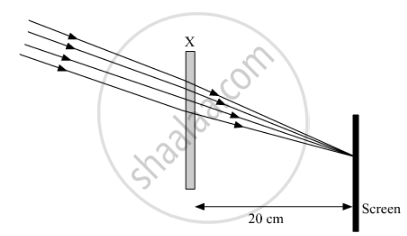
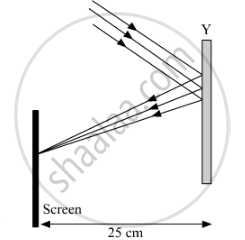
(A) Device X is a concave mirror and device Y is a convex lens, whose focal lengths are 20 cm and 25 cm respectively.
(B) Device X is a convex lens and device Y is a concave mirror, whose focal lengths are 10 cm and 25 cm respectively.
(C) Device X is a concave lens and device Y is a convex mirror, whose focal lengths are 20 cm and 25 cm respectively.
(D) Device X is a convex lens and device Y is a concave mirror, whose focal lengths are 20 cm and 25 cm respectively.
Where should an object be placed so that a real and inverted image of the same size as the object is obtained using a convex lens?
An object is placed at a distance of 12 cm from a convex lens of focal length 8 cm. Find :
1) the position of the image
2) nature of the image
A ray of light travelling in water emerges into air. Draw a ray-diagram indicating the change in its path.
If an object is placed at the focus of a convex lens, where is the image formed?
Where should an object be placed in front of a convex lens so as to obtain its virtual, erect and magnified image?
Draw a ray diagram to show the formation of a real magnified image by a convex lens. (In your sketch the position of object and image with respect to the principal focus of lens should be shown clearly).
State whether the convex lens has a real focus or a virtual focus.
- An object 3 cm high is placed 24 cm away from a convex lens of focal length 8 cm. Find by calculations, the position, height and nature of the image.
- If the object is moved to a point only 3 cm away from the lens, what is the new position, height and nature of the image?
- Which of the above two cases illustrates the working of a magnifying glass?
If the object is moved to a point only 3 cm away from the lens, what is the new position, height and nature of the image?
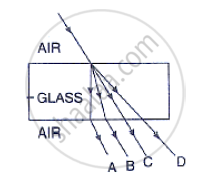
In figure , name the ray which represents the correct path of light while emerging out through
a glass block.
A convex lens forms an image of an object equal to the size of the object. State two more characteristics of the image.
To find the image distance for varying object distances in case of a convex lens of focal length 15 cm, a student obtains on a screen a sharp image of a bright object by placing it at 20 cm distance from the lens. After that he gradually moves the object away from the lens and each time focuses the image on the screen.
(a) In which direction-towards or away from the lens does he move the screen to focus the object?
(b) How does the size of image change?
(c) Approximately at what distance does he obtain the image of magnification –1?
(d) How does the intensity of image change as the object moves farther and farther away from the lens?
Observe the following figure and answer the questions.

a) Which optical instrument shows arrangement of lenses as shown in the figure?
b) Write in brief the working of this optical instrument.
c) How can we get different magnifications in this optical instrument?
d) Draw the figure again and labelled it properly
Simple microscope : Number of convex lens one : : compound microscope : _______
A beam of light is incident through the holes on side A and emerges out of the holes on the other face of the box as show in the figure. Which of the following could be inside the box?

