Advertisements
Advertisements
प्रश्न
Find the odd one out and give its explanation.
विकल्प
Eye piece
Magnifier
Kaleidoscope
Telescope
Advertisements
उत्तर
Kaleidoscope
Explanation-
Kaleidoscope uses mirrors while other devices make use of lenses.
APPEARS IN
संबंधित प्रश्न
"A convex lens can form a magnified erect as well as magnified inverted image of an object placed in front of it." Draw ray diagram to justify this statement stating the position of the object with respect to the lens in each case.
An object 5 cm is placed at a distance of 20 cm in front of a convex mirror of radius of curvature 30 cm. Find the position, nature and size of the image.
The diagram given alongside shows a ray of light entering a rectangular block of glass.
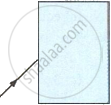
- Copy the diagram and draw the normal at the point of entry.
- Draw the approximate path of the ray of light through the glass block and out of the other side.
Draw a ray diagram to show the formation of a real magnified image by a convex lens. (In your sketch the position of object and image with respect to the principal focus of lens should be shown clearly).
An object is placed at a distance equal to 2f in front of a convex lens. Draw a labelled ray diagram to show the formation of image. State two characteristics of the image formed.
An object 4 cm high is placed at a distance of 10 cm from a convex lens of focal length 20 cm. Find the position, nature and size of the image.
Find the nature, position and magnification of the images formed by a convex lens of focal length 0.20 m if the object is placed at a distance of:
0.50 m
A student did an experiment with a convex lens. He put an object at different distances 25 cm, 30 cm, 40 cm, 60 cm and 120 cm from the lens. In each case he measured the distance of the image from the lens. His results were 100 cm, 24 cm, 60 cm, 30 cm and 40 cm, respectively. Unfortunately his results are written in wrong order.
Which of the object distances gives the biggest image?
What type of images can a convex lens make?
What kind of lens can form:
an inverted diminished image?
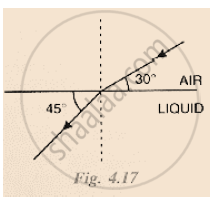
The diagram alongside shows the refraction of a ray of light from sir to a liquid.
(a) write the values of (i) angle of incidence, (ii) angle of refraction.
(b) use snell’s law to find the refractive index of liquid with respect to air.
Study the diagram given below.

- Name the lens LL’.
- What are the points O and O’ called?
- Complete the diagram to form the image of the object AB.
- State the three characteristics of the image.
- Name a device in which this action of lens is used.
The given below figure shows an object OA and its image IB formed by a lens
. 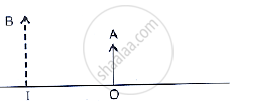
draw suitable rays to locate the lens and its focus.
A convex lens forms an image of an object equal to the size of the object. State two more characteristics of the image.
A student places a 8.0 cm tall object perpendicular to the principal axis of a convex lens of focal length 20 cm. The distance of the object from the lens is 30 cm. He obtains a sharp image of the object on a screen placed on the other side of the lens. What will be the nature (inverted, erect, magnified, diminished) of the image he obtains on a screen? Draw ray diagram to justify your answer.
What is the difference between a double convex and a bi-convex lens?
State the position of object, position of image, nature of image when: Convex lens is used in cine projector.
State the position of object, position of image, nature of image when: Convex lens is used as in searchlight.
A concave mirror and convex lens are held in water. What changes, if any, do you expect in their focal length?
Distinguish between:
Concave lens and Convex Lens
