Topics
Gravitation
- Concept of Gravitation
- Force and Motion
- Circular Motion and Centripetal Force
- Kepler’s Laws
- Law of Orbit or Kepler's First Law
- Law of Areas or Kepler's Second Law
- Law of Periods or Kepler's Third Law
- Newton's Universal Law of Gravitation
- Uniform Circular Motion (UCM)
- Earth’s Gravitational Force
- Earth’s Gravitational Acceleration
- Mass and Weight
- Gravitational Waves
- Free Fall
- Gravitational Potential Energy
- Escape Velocity
- Weightlessness in Space
Periodic Classification of Elements
- Classification of Elements
- Dobereiner’s Triads
- Newland's Law of Octaves
- Mendeleev’s Periodic Table
- Insights into Mendeleev’s Periodic Table
- Modern Periodic Law
- Modern Periodic Table
- Structure of the Modern Periodic Table
- Modern Periodic Table and Electronic Configuration of Elements
- Groups and Electronic Configuration
- Periods and Electronic Configuration
- Periodic Trends in the Modern Periodic Table
- Atomic Size
- Metallic and Non-metallic Characters
- Gradation in Halogen Family
Chemical Reactions and Equations
- Chemical Reaction
- Chemical Equations
- Balancing Chemical Equation
- Types of Chemical Reactions > Combination Reaction
- Types of Chemical Reactions > Decomposition Reaction
- Types of Chemical Reactions > Single Displacement Reaction
- Types of Chemical Reactions > Double Displacement Reaction
- Endothermic and Exothermic Processes
- Rate of Chemical Reaction
- Types of Chemical Reactions > Oxidation and Reduction Reactions
- Corrosion of Metals
- Factors Affecting the Rate of a Chemical Reaction
- Rancidity
Effects of Electric Current
- Electric Circuit
- Heating Effect of Electric Current
- Magnetic Effect of Electric Current
- Right-hand Thumb Rule
- Applications of Biot-Savart's Law > Magnetic Field at the Axis of a Circular Current-carrying Loop
- Applications of Ampere’s Circuital Law > Magnetic Field of a Long Straight Solenoid
- Force on a Current-Carrying Conductor Placed in a Uniform Magnetic Field
- Fleming’s Left Hand Rule
- Electric Motor
- Introduction to Electromagnetic Induction
- Galvanometer
- Faraday's Laws of Electromagnetic Induction
- Fleming’s Right Hand Rule
- Alternating current (AC) and Direct Current (DC)
- Electric Generator
Heat
Refraction of Light
Lenses
- Concept of Lenses
- Images Formed by Convex Lenses
- Images Formed by Concave Lenses
- Sign Convention
- Lens Formula and Magnification
- Magnification
- Power of a Lens
- Combination of Lenses
- Human Eye
- Defects of Vision and Their Corrections > Myopia
- Defects of Vision and Their Corrections > Hypermetropia
- Defects of Vision and Their Corrections > Presbyopia
- Apparent Size of an Object
- Use of Concave Lenses
- Use of Convex Lenses
- Persistence of Vision
Metallurgy
- Physical Properties of Metal
- Physical Properties of Non-metal
- Chemical Properties of Metal
- Reactions of Metals
- Reactivity Series of Metals
- Chemical Properties of Non-metal
- Ionic Compounds
- Metallurgy
- Basic Principles of Metallurgy > Concentration of Ores
- Basic Principles of Metallurgy > Extraction of Metals
- Basic Principles of Metallurgy > Refining of Metals
- Corrosion of Metals
- Prevention of Corrosion
Carbon Compounds
- Bonds in Carbon Compounds
- Carbon: A Versatile Element
- Hydrocarbons
- Straight chains, Branched chains, and Rings of Carbon atoms
- Functional Groups in Carbon Compounds
- Nomenclature
- The IUPAC System of Nomenclature
- Homologous Series
- Chemical Properties of Carbon Compounds > Combustion
- Chemical Properties of Carbon Compounds > Oxidation
- Chemical Properties of Carbon Compounds > Addition Reaction
- Chemical Properties of Carbon Compounds > Substitution Reaction
- Ethanol
- Ethanoic Acid
- Macromolecules and Polymers
Space Missions
School of Elements
The Magic of Chemical Reactions
- Types of Chemical Reactions > Combination Reaction
- Types of Chemical Reactions > Decomposition Reaction
- Types of Chemical Reactions > Single Displacement Reaction
- Types of Chemical Reactions > Double Displacement Reaction
- Chemical Properties of Carbon Compounds > Oxidation
- Types of Double Displacement: Neutralization Reaction
The Acid Base Chemistry
The Electric Spark
All about Electromagnetism
- Magnetic force
- Bar Magnet and Solenoid Analogy
- Right-hand Thumb Rule
- Applications of Biot-Savart's Law > Magnetic Field at the Axis of a Circular Current-carrying Loop
- Applications of Ampere’s Circuital Law > Magnetic Field of a Long Straight Solenoid
- Force on a Current-Carrying Conductor Placed in a Uniform Magnetic Field
- Electric Motor
- Introduction to Electromagnetic Induction
- Alternating-Current Generator
- Simple D.C. Motor
- Household Electrical Circuits
Wonders of Light 1
Wonders of Light 2
Striving for better Environment 1
- Abatement of Pollution
- Sustainable Use of Resources
- Introduction
- Applications
- Activity
Introduction
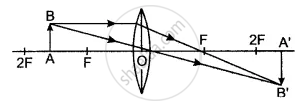
A convex lens is a type of lens that converges light rays, bringing them to a single point. It is made by joining two outwardly curved spherical surfaces, where the lens is thicker at the centre and thinner at the edges. Due to its converging property, it is also called a converging lens.
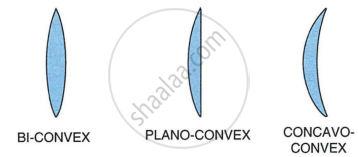
When parallel rays of light pass through a convex lens, they meet at a focal point on the other side. The distance from the centre of the lens to this focal point is called the focal length. If one surface of the lens is flat and the other is convex, it is called a plano-convex lens.

A convex lens may be of the following three kinds :
- Bi-convex or double-convex or equi-convex,
- Piano-convex, and
- Concavo-convex.
Applications
1. Vision and Magnification
- Human Eye: The natural lens in our eyes is convex and helps us see clearly.
- Magnifying Glass: A convex lens magnifies objects when they are placed closer than its focal length.
- Correcting Vision: It is used in spectacles to correct farsightedness (hypermetropia).
2. Optical Devices
- Cameras: Convex lenses focus light to form clear images.
- Projectors and Spectrographs: Used to focus and manipulate light.
3. Microscopes
A. Simple Microscope: It uses a single convex lens with a short focal length to magnify objects.
- Object within focal length → The image is virtual, erect, and magnified.
- Object at the focal point → The image is at infinity (parallel rays).
- Magnifies up to 20 times.
- It is used in watchmaking, jewellery inspection, and gem testing.

Simple microscope
B. Compound Microscope: It uses two convex lenses for higher magnification, making it suitable for observing cells, bacteria, and microorganisms.
- Objective Lens: It has a small focal length and a small cross-section. Forms the first magnified image of the object.
- Eyepiece Lens: It has a larger focal length and a bigger cross-section. Further magnifies the image formed by the objective lens.
- Magnification Process: Magnification occurs in two stages.
- The image from the objective lens acts as the object for the eyepiece lens.
- Both lenses are aligned along the same optical axis and fitted inside a metallic tube, allowing the distance between them to be adjusted for focus.

A compound microscope
4. Telescopes
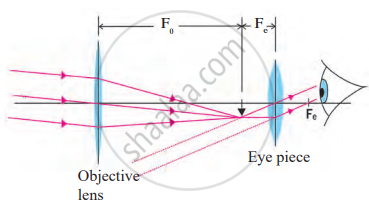
It is used for observing stars and planets by magnifying distant objects.
- Objective Lens: It has a large diameter and long focal length to collect maximum light.
- Eyepiece Lens: Smaller in size with a shorter focal length for enhanced magnification.
- Image Formation:
- The objective lens forms an image, which acts as the object for the eyepiece.
- The eyepiece further magnifies the image, producing the final view.
- Both lenses are aligned along the same optical axis in a metallic tube with an adjustable distance for focus.
Refracting telescope
Types of Telescopes:
- Refracting Telescope: Uses only lenses for magnification.
- Reflecting Telescope: Uses mirrors along with lenses for image formation.
5. Spectacles
Convex lenses are used in glasses to correct farsightedness, allowing clear vision for nearby objects.
Activity
Persistence of Vision Activity:
1. Incense Stick Rotation
- When a burning incense stick is rotated quickly in a circle, it appears as a continuous ring of fire instead of a single moving point.
- This happens due to persistence of vision, where the human eye retains an image for about 1/16th of a second after it disappears.
2. Cardboard with Cage and Bird
- A cage is drawn on one side of a cardboard and a bird is on the other side.
- When the thread is twisted and released, the cardboard spins rapidly, making it appear as if the bird is inside the cage.
- This is again due to persistence of vision, where the eye merges both images due to rapid motion.