Topics
Gravitation
- Concept of Gravitation
- Force and Motion
- Circular Motion and Centripetal Force
- Kepler’s Laws
- Law of Orbit or Kepler's First Law
- Law of Areas or Kepler's Second Law
- Law of Periods or Kepler's Third Law
- Newton's Universal Law of Gravitation
- Uniform Circular Motion (UCM)
- Earth’s Gravitational Force
- Earth’s Gravitational Acceleration
- Mass and Weight
- Gravitational Waves
- Free Fall
- Gravitational Potential Energy
- Escape Velocity
- Weightlessness in Space
Periodic Classification of Elements
- Classification of Elements
- Dobereiner’s Triads
- Newland's Law of Octaves
- Mendeleev’s Periodic Table
- Insights into Mendeleev’s Periodic Table
- Modern Periodic Law
- Modern Periodic Table
- Structure of the Modern Periodic Table
- Modern Periodic Table and Electronic Configuration of Elements
- Groups and Electronic Configuration
- Periods and Electronic Configuration
- Periodic Trends in the Modern Periodic Table
- Atomic Size
- Metallic and Non-metallic Characters
- Gradation in Halogen Family
Chemical Reactions and Equations
- Chemical Reaction
- Chemical Equations
- Balancing Chemical Equation
- Types of Chemical Reactions > Combination Reaction
- Types of Chemical Reactions > Decomposition Reaction
- Types of Chemical Reactions > Single Displacement Reaction
- Types of Chemical Reactions > Double Displacement Reaction
- Endothermic and Exothermic Processes
- Rate of Chemical Reaction
- Types of Chemical Reactions > Oxidation and Reduction Reactions
- Corrosion of Metals
- Factors Affecting the Rate of a Chemical Reaction
- Rancidity
Effects of Electric Current
- Electric Circuit
- Heating Effect of Electric Current
- Magnetic Effect of Electric Current
- Right-hand Thumb Rule
- Applications of Biot-Savart's Law > Magnetic Field at the Axis of a Circular Current-carrying Loop
- Applications of Ampere’s Circuital Law > Magnetic Field of a Long Straight Solenoid
- Force on a Current-Carrying Conductor Placed in a Uniform Magnetic Field
- Fleming’s Left Hand Rule
- Electric Motor
- Introduction to Electromagnetic Induction
- Galvanometer
- Faraday's Laws of Electromagnetic Induction
- Fleming’s Right Hand Rule
- Alternating current (AC) and Direct Current (DC)
- Electric Generator
Heat
Refraction of Light
Lenses
- Concept of Lenses
- Images Formed by Convex Lenses
- Images Formed by Concave Lenses
- Sign Convention
- Lens Formula and Magnification
- Magnification
- Power of a Lens
- Combination of Lenses
- Human Eye
- Defects of Vision and Their Corrections > Myopia
- Defects of Vision and Their Corrections > Hypermetropia
- Defects of Vision and Their Corrections > Presbyopia
- Apparent Size of an Object
- Use of Concave Lenses
- Use of Convex Lenses
- Persistence of Vision
Metallurgy
- Physical Properties of Metal
- Physical Properties of Non-metal
- Chemical Properties of Metal
- Reactions of Metals
- Reactivity Series of Metals
- Chemical Properties of Non-metal
- Ionic Compounds
- Metallurgy
- Basic Principles of Metallurgy > Concentration of Ores
- Basic Principles of Metallurgy > Extraction of Metals
- Basic Principles of Metallurgy > Refining of Metals
- Corrosion of Metals
- Prevention of Corrosion
Carbon Compounds
- Bonds in Carbon Compounds
- Carbon: A Versatile Element
- Hydrocarbons
- Straight chains, Branched chains, and Rings of Carbon atoms
- Functional Groups in Carbon Compounds
- Nomenclature
- The IUPAC System of Nomenclature
- Homologous Series
- Chemical Properties of Carbon Compounds > Combustion
- Chemical Properties of Carbon Compounds > Oxidation
- Chemical Properties of Carbon Compounds > Addition Reaction
- Chemical Properties of Carbon Compounds > Substitution Reaction
- Ethanol
- Ethanoic Acid
- Macromolecules and Polymers
Space Missions
School of Elements
The Magic of Chemical Reactions
- Types of Chemical Reactions > Combination Reaction
- Types of Chemical Reactions > Decomposition Reaction
- Types of Chemical Reactions > Single Displacement Reaction
- Types of Chemical Reactions > Double Displacement Reaction
- Chemical Properties of Carbon Compounds > Oxidation
- Types of Double Displacement: Neutralization Reaction
The Acid Base Chemistry
The Electric Spark
All about Electromagnetism
- Magnetic force
- Bar Magnet and Solenoid Analogy
- Right-hand Thumb Rule
- Applications of Biot-Savart's Law > Magnetic Field at the Axis of a Circular Current-carrying Loop
- Applications of Ampere’s Circuital Law > Magnetic Field of a Long Straight Solenoid
- Force on a Current-Carrying Conductor Placed in a Uniform Magnetic Field
- Electric Motor
- Introduction to Electromagnetic Induction
- Alternating-Current Generator
- Simple D.C. Motor
- Household Electrical Circuits
Wonders of Light 1
Wonders of Light 2
Striving for better Environment 1
- Abatement of Pollution
- Sustainable Use of Resources
Introduction:
An electric generator (also known as a dynamo) is a device that converts mechanical energy into electrical energy using the principle of electromagnetic induction. The mechanical energy required to operate the generator is provided by sources such as steam turbines, gas turbines, and wind turbines. Generators supply most of the electricity required for power grids.
History of Electric Generators:
Before the discovery of the relationship between electricity and magnetism, electrostatic generators were used. However, they were inefficient due to
- Difficulty in insulating high-voltage machines
- Low power output
To overcome this, Michael Faraday invented the first electromagnetic generator, called the Faraday Disc, in 1831.
Working of a Generator: Generators do not create electricity. Instead, they use mechanical energy to move electric charges present in their wire windings, generating an electric current.
Principle of Operation:
Modern generators work based on Faraday’s Law of Electromagnetic Induction, which states:
"A current is induced in a conductor when it moves through a magnetic field, causing a voltage difference and the flow of electric charges."
Types of Electric Generator
Electric generators are classified based on the type of current they produce:
1. AC Generators (Alternating Current Generators)
- It is also known as alternators.
- Converts mechanical energy into alternating current (AC).
- Used in power plants for large-scale electricity generation.
- It can be single-phase (for household use) or three-phase (for industries and transmission).
- And works with slip rings to produce a continuously alternating current.

2. DC Generators (Direct Current Generators)
- It converts mechanical energy into direct current (DC).
- Unlike AC generators, DC generators use a split-ring commutator to maintain a one-directional current flow.
- It is commonly used in battery charging, electroplating, and traction systems.
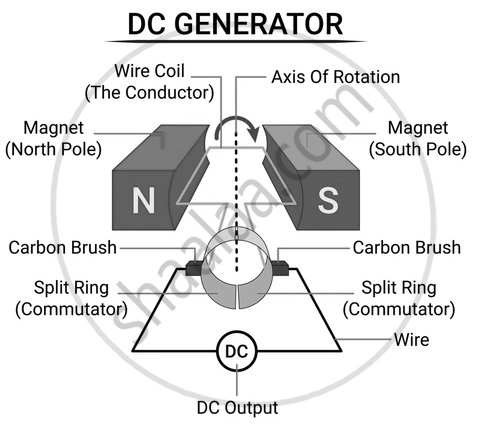
Classified into three types:
- Shunt Generators: Used in battery charging applications.
- Series Generators: Commonly used in street lighting.
- Compound-Wound Generators: Found in industrial equipment for stable power supply.
Components of an Electric Generator
1. Basic Electric Generator (Conceptual, as shown in textbooks)
- Coil (ABCD): Conducts electricity and rotates in the magnetic field.
- Magnetic Field: Provided by a permanent magnet or electromagnet.
- Slip Rings (or Split Rings for DC Generators): Transfer current while rotating.
- Carbon Brushes: Maintain electrical contact with rings.
- Axle: Rotates the coil.
- External Circuit (Galvanometer, Load): Detects or uses the generated electricity.
2. Fuel-Based Electric Generator (Practical, Large-Scale)
- Frame: Structural support.
- Engine: Converts fuel energy into mechanical energy.
- Alternator: Converts mechanical rotation into electricity.
- Fuel System: Supplies petrol, diesel, or gas for operation.
- Voltage Regulator: Maintains stable output voltage.
- Cooling System: Prevents overheating.
- Lubrication System: Ensures smooth operation of moving parts.
- Exhaust System: Removes combustion waste gases.
- Battery Charger: Keeps the starter battery charged.
- Control Panel: Manages generator operations.
Working of an AC Generator
1. A coil ABCD is placed between the north (N) and south (S) poles of a magnet.
2. The ends of the coil are connected to conducting rings (R1 and R2) via carbon brushes (B1 and B2).
3. The axle attached to the coil is rotated mechanically (e.g., using a turbine).
4. As the coil rotates, the branches AB move up and CD moves down (clockwise motion).
5. According to Fleming’s Right-Hand Rule, an induced current is generated:
- First half rotation: Current flows from A → B → C → D in the coil.
- In the external circuit, current flows from B2 to B1 through the galvanometer.
6. After half a rotation, the coil switches position:
- AB and CD interchange places, reversing the direction of the induced current.
- The new current flows as D → C → B → A in the coil.
- In the external circuit, current now flows from B1 to B2.
7. This continuous reversal of current direction produces Alternating Current (AC).
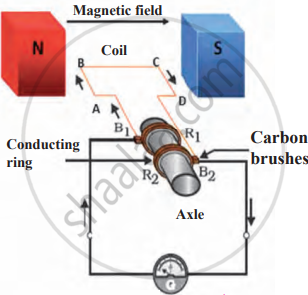
Electric generator
Conversion of an AC Generator into a DC Generator:
- In an AC generator, the current reverses every half cycle.
- To produce Direct Current (DC) (which flows in only one direction), the conducting rings (R1, R2) are replaced with a split-ring commutator.
- The split ring ensures that the coil side moving upwards is always connected to one brush and the side moving downwards is connected to the other brush.
- This keeps the current in the same direction in the external circuit, producing DC output.
AC Generator vs. DC Generator
| Feature | AC Generator | DC Generator |
| Current Type | Produces Alternating Current (AC) | Produces Direct Current (DC) |
| Ring Type | Uses two conducting rings (slip rings) | Uses a split-ring commutator |
| Current Direction | Reverses direction after every half cycle | Flows in one direction |
| Usage | Power plants, household electricity supply | Batteries, charging devices, electroplating |
Application of an Electric Generator
- Main power source for cities and power grids.
- Backup power for homes, businesses, and hospitals.
- It is used on construction sites where power is not yet installed.
- Energy-efficient, reducing fuel consumption.
- It is used in laboratories for experiments requiring specific voltage outputs.
- Drives motors in industries.
- And used in transportation, including trains and ships.
Key Points: Electric Generator
- Electromagnetic induction can be used to generate a large current by rotating a coil in a magnetic field, converting mechanical energy into electrical energy.
- In an AC generator, a coil rotates between magnetic poles, and the induced current reverses direction every half-rotation, producing alternating current (AC).
- Carbon brushes and conducting rings connect the rotating coil to the external circuit; the current direction in the circuit reverses after each half-turn.
- Using a multi-turn coil significantly increases the magnitude of the generated current.
- A DC generator uses a split ring instead of two separate rings to maintain unidirectional current in the external circuit.
Related QuestionsVIEW ALL [16]
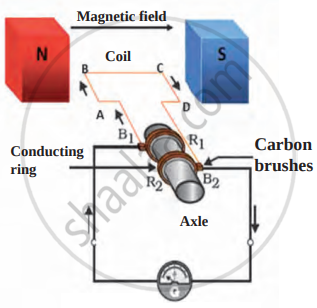
Match the following:
| 1. | Electric generator | a. | Electromagnetic induction |
| 2. | Dynamo | b. | Fleming’s left-hand rule |
| 3. | Magnetic field lines | c. | Slip rings |
| 4. | Electric motor | d. | North to south |
