- Hypermetropia is a condition in which distant objects are seen clearly, but nearby objects appear blurred.
- The near point shifts beyond 25 cm, making close-up tasks like reading difficult.
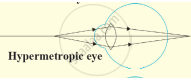
- The image of nearby objects forms behind the retina.
- Causes include reduced curvature of the lens or cornea and shortening of the eyeball.
- It is corrected using a convex lens of positive power, which converges light rays to focus the image on the retina.
Topics
Chemical Substances-Nature and Behaviour
Chemical Reactions and Equations
- Chemical Reaction
- Characteristics of Chemical Reactions
- Chemical Equations
- Balanced and Unbalanced Chemical Equations
- Balancing Chemical Equation
- Types of Chemical Reactions > Combination Reaction
- Types of Chemical Reactions > Decomposition Reaction
- Types of Chemical Reactions > Single Displacement Reaction
- Types of Chemical Reactions > Double Displacement Reaction
- Types of Chemical Reactions > Reversible and Irreversible Reactions
- Types of Chemical Reactions > Oxidation and Reduction Reactions
- Corrosion of Metals
- Rancidity
World of Living
Acids, Bases and Salts
- Introduction to Acids, Bases and Indicators
- Indicators for Testing Acids and Bases
- Acids
- Properties of Acids
- Common Properties of Acids
- Uses of Acids
- Bases
- Properties of Bases
- Uses of Bases
- Chemical Properties of Acids and Bases
- Common Properties of Acids and Bases
- Strength of Acid and Base Solutions : pH Scale
- Universal Indicator
- Importance of pH in Everyday Life
- Salts
- Salts > Family of Salts
- Salts > pH of Salts
- Common Salt
- Sodium hydroxide
- Washing Soda
- Baking Soda
- Bleaching Powder
- Plaster of Paris
- Water of Crystallisation: Hydrated Salts
Natural Phenomena
Metals and Non-metals
Carbon and its Compounds
Effects of Current
Life Processes
Natural Resources
Control and Coordination
How do Organisms Reproduce?
- DNA Copying and Variation
- The Importance of Variation
- Reproduction
- Modes of Reproduction
- Asexual Reproduction
- Asexual Reproduction in Unicellular Organisms > Binary Fission
- Binary Fission > Simple Binary Fission
- Binary Fission > Longitudinal Binary Fission
- Binary Fission > Transverse Binary Fission
- Asexual Reproduction in Unicellular Organisms > Multiple Fission
- Asexual Reproduction in Multicellular Organisms > Fragmentation
- Asexual Reproduction in Multicellular Organisms > Regeneration
- Asexual Reproduction in Unicellular Organisms > Budding
- Asexual Reproduction in Multicellular Organisms > Budding
- Asexual Reproduction in Multicellular Organisms > Spore Formation
- Vegetative Reproduction or Vegetative Propagation
- Natural Vegetative Propagation
- Artificial Vegetative Propagation
- Tissue Culture
- Sexual Reproduction
- Sexual Reproduction in Plants
- Pollination
- Self-pollination
- Cross-pollination
- Fertilisation in Flowering Plants
- Formation of Seed and Fruit
- Seed Germination
- Sexual Reproduction in Animals
- Puberty
- The Male Reproductive System
- The Female Reproductive System
- Fertilization in Humans
- Menstrual Cycle (Ovarian Cycle)
- Major Events of Menstrual Cycle
- Menarche and Menopause
- Birth Control
- Natural Contraceptive Methods
- Artificial Contraceptive Methods
- Induced Abortion or Medical Termination of Pregnancy (MTP)
- Sexually Transmitted Diseases (STD) or Sexually Transmitted Infections (STI)
- Concept of Reproductive Health
Heredity
- Heredity
- Variation
- Accumulation of Variation During Reproduction
- Gregor Johann Mendel – Father of Genetics
- Monohybrid Cross
- Dihybrid Cross
- Characteristics (or Traits) Transmitted to Progeny
- Inheritance of Blood Groups
- Sex Determination in Humans
- Acquired and Inherited Traits
Light – Reflection and Refraction
- Nature of Light
- Reflection of Light
- Reflection of Light from Plane Surfaces: Plane Mirror
- Law of Reflection of Light
- Regular Reflection and Diffuse Reflection of Light
- Objects and Images
- Images Formed by a Plane Mirrors
- The Position of Image Formed in a Plane Mirror
- Uses of Plane Mirrors
- Spherical Mirrors
- Image Formation by Spherical Mirrors
- Rules for Obtaining Images Formed by Concave Mirrors
- Formation of Different Types of Images by a Concave Mirror
- Representation of Images Formed by Spherical Mirrors Using Ray Diagrams
- Sign Convention for Reflection by Spherical Mirrors
- Mirror Formula and Magnification
- Rules for Obtaining Images Formed by Convex Mirrors
- Formation of Image by a Convex Mirror
- Refraction of Light
- Effects of Refraction of Light
- Laws of Refraction of Light
- Refraction through a Rectangular Glass Slab
- The Refractive Index
- Refraction by Spherical Lenses
- Rules for Obtaining Images Formed by Convex Lenses
- Formation of Different Types of Images by a Convex Lens
- Image Formation by Lenses
- Image Formation in Lenses Using Ray Diagrams
- Sign Convention for Reflection by Spherical Mirrors
- Lens Formula and Magnification
- Lens Formula and Magnification Formulae for a Concave Lens
- Power of a Lens
The Human Eye and the Colourful World
- Human Eye
- Working of the Eye
- Rods and Cones
- Power of Accommodation
- Range of Vision of a Normal Human Eye
- Advantages of Having Two Eyes for Vision
- Defects of Vision and Their Corrections > Myopia
- Defects of Vision and Their Corrections > Hypermetropia
- Defects of Vision and Their Corrections > Presbyopia
- Glass Prism
- Refraction of Light through a Prism
- Dispersion of Light Through a Prism
- The Rainbow
- Atmospheric Refraction
- Scattering of Light
Electricity
- Electric Charges
- Conductors and Insulators
- Electric Potential and Potential Difference
- Electric Current
- Electric Circuit
- Circuit Diagram
- Ohm's Law
- Resistance of a Conductor
- Graph Between V and I
- Experiment to Verify Ohm's Law
- Good Conductors, Resistors and Insulators
- Factors Affecting the Resistance of a Conductor
- Resistivity
- Resistance of a System of Resistors
- Resistors in Series
- Resistors in Parallel
- Domestic Electric Circuits
- Heating Effect of Electric Current
- Practical Applications of Heating Effect of Electric Current
- Electric Power
- Commercial Unit of Electrical Energy
- Effects Produced by Electric Current
- Applications of the Heating Effect of Current
Magnetic Effects of Electric Current
- Introduction to Magnets and Their Properties
- Electromagnetism
- Magnetic Field and Field Lines
- Magnetic Field of Earth
- Magnetic Effect of Current (or Electromagnetism)
- Magnetic Field Due to a Current-Carrying Conductor
- Magnetic Field due to a Current through a Straight Conductor
- Right-hand Thumb Rule
- Magnetic Field due to a Current through a Circular Loop
- Magnetic Field due to a Current in a Solenoid
- Electromagnet
- Magnetism in Human Beings
- Force on a Current-Carrying Conductor in a Magnetic Field
- Domestic Electric Circuits
Our Environment
Maharashtra State Board: Class 10
Hypermetropia and Its Causes
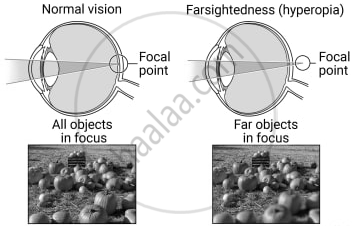
Hypermetropia (Hyperopia), also known as farsightedness, is a common vision defect where a person can see distant objects clearly, but nearby objects appear blurry. This occurs because light rays focus behind the retina instead of directly on it. It is common in newborn babies due to small eyeball size but often corrects itself as the eyeball grows.

Farsightedness
Hypermetropia occurs due to structural abnormalities in the eye that prevent proper light focusing.
Structural Causes:
- Shortened eyeball → Light focuses behind the retina, causing blurred vision.
- Flattened cornea or lens → Reduces the converging power of the eye, preventing proper focus.
- Increased focal length of the eye lens → Leads to improper light convergence.
- Stiffening of ciliary muscles → Reduces the ability of the eye to adjust its focus.
Maharashtra State Board: Class 10
Types and Symptoms of Hypermetropia
- Simple Hypermetropia: It is the most common type. Includes axial hypermetropia (short eyeball) and curvature hypermetropia (flat cornea/lens).
- Pathological Hypermetropia: It is caused by congenital (birth-related) or acquired conditions. Includes senile (age-related), positional, aphakic (absence of lens), and consecutive hypermetropia.
- Functional Hypermetropia: Occurs due to third cranial nerve palsy or internal ophthalmoplegia, causing paralysis of accommodation.
Hypermetropia is categorised based on severity (lens power required for correction):
| Severity | Power (Diopters, D) |
|---|---|
| Low | Up to +2 D |
| Moderate | +2.2 to +5 D |
| High | More than +5 D |
Symptoms of Hypermetropia:
- Blurred vision while focusing on close objects.
- Eye strain and fatigue while reading or working on screens.
- Headaches, particularly in the forehead region.
- Difficulty in adjusting focus, causing discomfort in switching from distant to near objects.
- Double vision in severe cases due to excessive eye strain.
Maharashtra State Board: Class 10
Hypermetropia Correction and Treatment
A. Spectacles and Contact Lenses
- Convex lenses (positive power lenses) are used to converge incoming light rays before they reach the eye lens.
- The eye lens then further converges them, forming a sharp image on the retina.
- Glasses and contact lenses are the most common correction methods.
B. Surgical Treatments for Hypermetropia
- Photorefractive Keratectomy (PRK): It removes a small portion of the cornea to improve refraction. May cause temporary corneal haze and astigmatism.
- Laser Epithelial Keratomileusis (LASEK): It is similar to PRK but uses alcohol to loosen the corneal surface before reshaping it.
- Laser-Assisted In Situ Keratomileusis (LASIK): It reshapes the cornea to correct the refractive error, eliminating the need for glasses or contact lenses.
CBSE: Class 10
Maharashtra State Board: Class 10
Maharashtra State Board: Class 10
 : Concave lens : :
  : ______
