Topics
Electric Charges and Fields
- Electric Charges
- Conductors and Insulators
- Properties of Electric Charge
- Coulomb’s Law
- Forces between Multiple Charges
- Electric Field
- Electric Field Due to a System of Charges
- Physical Significance of Electric Field
- Electric Field Lines
- Electric Flux
- Electric Dipole
- Dipole in a Uniform External Field
- Continuous Charge Distribution
- Gauss’s Law
- Application of Gauss' Law
Electrostatics
Current Electricity
Electrostatic Potential and Capacitance
- Electric Potential and Potential Energy
- Electrostatic Potential
- Electric Potential Due to a Point Charge
- Potential Due to an Electric Dipole
- Potential due to a System of Charges
- Equipotential Surfaces
- Relation Between Electric Field and Electrostatic Potential
- Potential Energy of a System of Charges
- Potential Energy of a Single Charge
- Potential Energy of a System of Two Charges in an External Field
- Potential Energy of a Dipole in an External Field
- Electrostatics of Conductors
- Dielectrics and Polarisation
- Capacitors and Capacitance
- The Parallel Plate Capacitor
- Effect of Dielectric on Capacitance
- Combination of Capacitors
- Energy Stored in a Charged Capacitor
Magnetic Effects of Current and Magnetism
Current Electricity
- Electric Current
- Electric Currents in Conductors
- Ohm's Law
- Drift of Electrons and the Origin of Resistivity
- Mobility of Electrons
- Limitations of Ohm’s Law
- Resistivity of Various Materials
- Temperature Dependence of Resistivity
- Electrical Energy and Power in Conductors
- Cells, EMF, and Internal Resistance
- Cells in Series and in Parallel
- Kirchhoff’s Laws
- Wheatstone Bridge
Moving Charges and Magnetism
- Electromagnetism
- Magnetic force
- Motion in a Magnetic Field
- Magnetic Field Due to a Current-carrying Conductor: Biot-savart's Law
- Applications of Biot-Savart's Law > Magnetic Field at the Axis of a Circular Current-carrying Loop
- Ampere’s Circuital Law
- Solenoid
- Force Between Two Parallel Currents (Ampere’s Law)
- Torque on a Rectangular Current Loop in a Uniform Magnetic Field
- Circular Current Loop as a Magnetic Dipole
- Moving Coil Galvanometer
- Kirchhoff’s Laws
Electromagnetic Induction and Alternating Currents
Magnetism and Matter
Electromagnetic Waves
Optics
Electromagnetic Induction
Alternating Current
Dual Nature of Radiation and Matter
Electromagnetic Waves
Atoms and Nuclei
Electronic Devices
Ray Optics and Optical Instruments
- Ray Optics Or Geometrical Optics
- Reflection of Light by Spherical Mirrors
- Sign Convention for Reflection by Spherical Mirrors
- Focal Length of Spherical Mirrors
- Mirror Equation of Spherical Mirrors
- Refraction of Light
- Total Internal Reflection
- Applications of Total Internal Reflection
- Refraction at a Spherical Surfaces
- Refraction by a Lens
- Power of a Lens
- Combined Focal Length of Two Thin Lenses in Contact
- Refraction of Light through a Prism
- Introduction to Optical Instruments
- Microscope and it’s types
- Telescope
Communication Systems
Wave Optics
- Introduction to Wave Optics
- Huygens Principle
- Refraction of a Plane Wave
- Refraction at a Rarer Medium
- Reflection of a Plane Wave by a Plane Surface
- Coherent and Incoherent Addition of Waves
- Interference of Light Waves and Young’s Experiment
- Diffraction of Light
- The Single Slit
- Seeing the Single Slit Diffraction Pattern
- Polarisation of Light
Dual Nature of Radiation and Matter
- Understanding Dual Nature of Radiation and Matter
- Electron Emission
- Photoelectric Effect - Hertz’s Observations
- Photoelectric Effect - Hallwachs’ and Lenard’s Observations
- Experimental Study of Photoelectric Effect
- Effects of Intensity and Frequency on Photocurrent
- Photoelectric Effect and Wave Theory of Light
- Einstein’s Photoelectric Equation: Energy Quantum of Radiation
- Particle Nature of Light: The Photon
- Wave Nature of Matter
The Special Theory of Relativity
Atoms
Nuclei
Semiconductor Electronics - Materials, Devices and Simple Circuits
Communication Systems
- Detection of Amplitude Modulated Wave
- Production of Amplitude Modulated Wave
- Basic Terminology Used in Electronic Communication Systems
- Sinusoidal Waves
- Modulation and Its Necessity
- Amplitude Modulation (AM)
- Need for Modulation and Demodulation
- Satellite Communication
- Propagation of EM Waves
- Bandwidth of Transmission Medium
- Bandwidth of Signals
The Special Theory of Relativity
- The Special Theory of Relativity
- The Principle of Relativity
- Maxwell'S Laws
- Kinematical Consequences
- Dynamics at Large Velocity
- Energy and Momentum
- The Ultimate Speed
- Twin Paradox
Maharashtra State Board: Class 7, 11
CISCE: Class 10, 12
Tamil Nadu Board of Secondary Education: Class 8, 9
National Testing Agency: Class 12
Introduction
Electric charge is a fundamental property of matter that causes it to experience a force in the presence of other charges. It is as basic to physics as mass — but instead of gravity, charge governs electric and magnetic phenomena.
Real-Life Analogy: When you rub a balloon on your hair and it sticks to a wall, you are witnessing electric charge transfer — the same principle that governs lightning, photocopiers, and static shocks from a car door.
Maharashtra State Board: Class 7, 11
CISCE: Class 12
Tamil Nadu Board of Secondary Education: Class 8, 9
Definition: Electric Charge
Electric charge is an intrinsic property of certain fundamental particles (like electrons and protons) that gives rise to electric and magnetic forces, causing them to experience a force when placed in an electromagnetic field.
OR
Electric charge is the physical property of matter that causes it to experience a force when placed in an electric field.
Key facts:
- SI Unit: Coulomb (C)
- Dimensional Formula: [A T] (Ampere × Time)
- Two types exist: positive and negative
Tamil Nadu Board of Secondary Education: Class 8
National Testing Agency: Class 12
Types of Electric Charge
| Aspect | Positive Charge | Negative Charge |
|---|---|---|
| Carrier particle | Proton (or absence of electrons) | Electron |
| Origin of name | Named by Benjamin Franklin | Named by Benjamin Franklin |
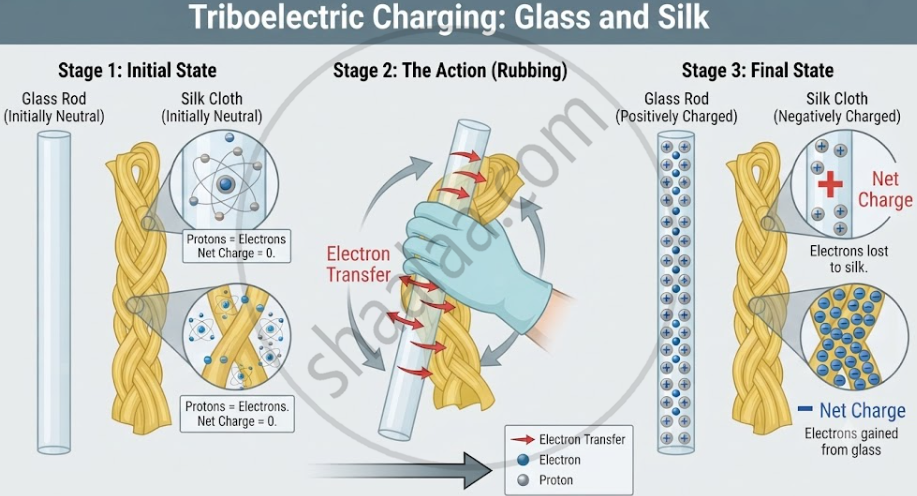
| Classic experiment | Glass rod rubbed with silk | Plastic/ebonite rod rubbed with wool/fur |
| Behaviour | Repels like charges, attracts unlike | Repels like charges, attracts unlike |
Golden Rule: Like charges repel; unlike charges attract.
Maharashtra State Board: Class 11
CISCE: Class 10
Tamil Nadu Board of Secondary Education: Class 8
Properties of Electric Charge
- Charge is a scalar quantity (adds algebraically, not vectorially)
- Charge is conserved — total charge of an isolated system remains constant
- Charge is quantized — it exists only in integral multiples of the elementary charge
- Charge is additive — net charge of a system is the algebraic sum of all individual charges
- Charge is invariant — does not change with the speed of the charged particle (unlike mass)
Tamil Nadu Board of Secondary Education: Class 8
Elementary Charge
- The smallest amount of charge that can exist freely is called the elementary charge (e).
- Its value is 1.602 × 10⁻¹⁹ C — this is the charge on each proton and electron.
- Protons carry positive elementary charge (+e), and electrons carry negative elementary charge (−e).
- Since protons and electrons are equal in number, an atom is electrically neutral.
Maharashtra State Board: Class 7
CISCE: Class 10
Tamil Nadu Board of Secondary Education: Class 8, 9
National Testing Agency: Class 12
Electric Charges Inside an Atom
- Every atom has a nucleus with positively charged protons and neutral neutrons, surrounded by negatively charged electrons.
- If an electron is removed from an atom, it becomes a positive ion.
- If an electron is added to an atom, it becomes a negative ion.
- When a plastic comb is rubbed on dry hair, electrons transfer from hair to the comb — hair becomes positive, the comb becomes negative.
Tamil Nadu Board of Secondary Education: Class 8, 9
National Testing Agency: Class 12
Measuring Electric Charge
- The unit of charge is coulomb (C); the charge of an electron is e = 1.6 × 10⁻¹⁹ C.
- Any charge q must be an integer multiple of e: q = ne, where n is a whole number.
- One coulomb contains 6.25 × 10¹⁸ electrons.
- Practical sub-units: 1 µC = 10−6 C, 1 nC = 10−9 C, 1 pC = 10−12 C.
Conservation and Additivity of Charge
- Law of Conservation of Charge: Charge can neither be created nor destroyed; it can only be transferred from one body to another.
- Additivity: If a system has charges q1, q2, q3, ... qn, the total charge is:
Q = q1 + q2 + q3 + ... +qn
Analogy: Think of charge like money in a closed economy — it only moves between accounts (bodies); no new "charge currency" is printed or destroyed.
CISCE: Class 10, 12
Concept of Charge (Conductors & Insulators)
- When two non-conducting bodies are rubbed, electrons transfer — the body gaining electrons becomes negatively charged, the body losing electrons becomes positively charged.
- The SI unit of charge is coulomb (C); smaller units are milli-coulomb (mC = 10−3 C), micro-coulomb (µC = 10−6 C), nano-coulomb (nC = 10−9 C).
- Charge on a body is always q = ±ne, an integer multiple of the electron charge.
- In an insulator, charge stays static at the point of excess or deficit of electrons — it does not flow.
- In a conductor, free electrons can move and flow throughout the entire volume.
CISCE: Class 12
Charging by Induction
- When an uncharged conductor is brought near a charged body (without contact), the nearer side develops opposite charge and the far side develops similar charge — this is called induction.
- In induction, no charge is transferred between the charged body and the conductor.
- When the charged body is removed, the charges in the conductor redistribute freely again.
| Method | Process | Contact Required? | Result |
| Friction | Rubbing two neutral bodies together | Yes | Both bodies get opposite charges |
| Conduction | Charged body touches neutral body | Yes | Neutral body gets same charge as source |
| Induction | Charged body brought near (not touching) a neutral conductor | No | Near side gets opposite charge, far side gets same charge |
CISCE: Class 12
Historical Background & Electrostatics
- Term "electricity" derived from Greek word elektron (amber), as amber attracted light objects when rubbed
- Benjamin Franklin introduced the convention of naming charges "positive" and "negative"
- Charles Coulomb later quantified the force between charges (Coulomb's Law)
Conductors vs Insulators
| Feature | Conductors | Insulators |
|---|---|---|
| Free electrons | Abundant | Very few / none |
| Charge flow | Easy | Difficult/Not possible |
| Examples | Copper, silver, aluminium | Rubber, glass, plastic |
| Use in charging | Charge spreads over surface | Charge stays localized |
Test Yourself
Video Tutorials
Shaalaa.com | Electric Charges and Fields part 1 (Introduction)
Series: 1
00:04:44 undefined
00:12:02 undefined
00:18:48 undefined
00:05:41 undefined
00:08:43 undefined
00:06:38 undefined
00:12:41 undefined
00:02:36 undefined
