Topics
Electric Charges and Fields
- Electric Charge
- Conductors and Insulators
- Properties of Electric Charge
- Coulomb’s Law
- Forces between Multiple Charges
- Electric Field
- Electric Field Due to a System of Charges
- Physical Significance of Electric Field
- Electric Field Lines
- Electric Flux
- Electric Dipole
- Dipole in a Uniform External Field
- Continuous Charge Distribution
- Gauss’s Law
- Application of Gauss' Law
Electrostatics
Current Electricity
Electrostatic Potential and Capacitance
- Electric Potential and Potential Energy
- Electrostatic Potential
- Electric Potential Due to a Point Charge
- Potential Due to an Electric Dipole
- Potential due to a System of Charges
- Equipotential Surfaces
- Relation Between Electric Field and Electrostatic Potential
- Potential Energy of a System of Charges
- Potential Energy of a Single Charge
- Potential Energy of a System of Two Charges in an External Field
- Potential Energy of a Dipole in an External Field
- Electrostatics of Conductors
- Dielectrics and Polarisation
- Capacitors and Capacitance
- The Parallel Plate Capacitor
- Effect of Dielectric on Capacitance
- Combination of Capacitors
- Energy Stored in a Charged Capacitor
Magnetic Effects of Current and Magnetism
Current Electricity
- Electric Current
- Electric Currents in Conductors
- Ohm's Law
- Drift of Electrons and the Origin of Resistivity
- Mobility of Electrons
- Limitations of Ohm’s Law
- Resistivity of Various Materials
- Temperature Dependence of Resistivity
- Electrical Energy and Power in Conductors
- Cells, EMF, and Internal Resistance
- Cells in Series and in Parallel
- Kirchhoff’s Laws
- Wheatstone Bridge
Electromagnetic Induction and Alternating Currents
Moving Charges and Magnetism
- Electromagnetism
- Magnetic force
- Motion in a Magnetic Field
- Magnetic Field Due to a Current-carrying Conductor: Biot-savart's Law
- Applications of Biot-Savart's Law > Magnetic Field at the Axis of a Circular Current-carrying Loop
- Ampere’s Circuital Law
- Solenoid
- Force Between Two Parallel Currents (Ampere’s Law)
- Torque on a Rectangular Current Loop in a Uniform Magnetic Field
- Circular Current Loop as a Magnetic Dipole
- Moving Coil Galvanometer
- Kirchhoff’s Laws
Magnetism and Matter
Electromagnetic Waves
Electromagnetic Induction
Optics
Alternating Current
Dual Nature of Radiation and Matter
Electromagnetic Waves
Atoms and Nuclei
Ray Optics and Optical Instruments
- Ray Optics Or Geometrical Optics
- Reflection of Light by Spherical Mirrors
- Sign Convention for Reflection by Spherical Mirrors
- Focal Length of Spherical Mirrors
- Mirror Equation of Spherical Mirrors
- Refraction of Light
- Total Internal Reflection
- Applications of Total Internal Reflection
- Refraction at a Spherical Surfaces
- Refraction by a Lens
- Power of a Lens
- Combined Focal Length of Two Thin Lenses in Contact
- Refraction Through a Prism
- Introduction to Optical Instruments
- Microscope and it’s types
- Telescope
Electronic Devices
Communication Systems
Wave Optics
- Introduction to Wave Optics
- Huygens Principle
- Refraction of a Plane Wave
- Refraction at a Rarer Medium
- Reflection of a Plane Wave by a Plane Surface
- Coherent and Incoherent Addition of Waves
- Interference of Light Waves and Young’s Experiment
- Diffraction of Light
- The Single Slit
- Seeing the Single Slit Diffraction Pattern
- Polarisation of Light
Dual Nature of Radiation and Matter
- Understanding Dual Nature of Radiation and Matter
- Electron Emission
- Photoelectric Effect - Hertz’s Observations
- Photoelectric Effect - Hallwachs’ and Lenard’s Observations
- Experimental Study of Photoelectric Effect
- Effects of Intensity and Frequency on Photocurrent
- Photoelectric Effect and Wave Theory of Light
- Einstein’s Photoelectric Equation: Energy Quantum of Radiation
- Particle Nature of Light: The Photon
- Wave Nature of Matter
The Special Theory of Relativity
Atoms
Nuclei
Semiconductor Electronics - Materials, Devices and Simple Circuits
Communication Systems
- Detection of Amplitude Modulated Wave
- Production of Amplitude Modulated Wave
- Basic Terminology Used in Electronic Communication Systems
- Sinusoidal Waves
- Modulation and Its Necessity
- Amplitude Modulation (AM)
- Need for Modulation and Demodulation
- Satellite Communication
- Propagation of EM Waves
- Bandwidth of Transmission Medium
- Bandwidth of Signals
The Special Theory of Relativity
- The Special Theory of Relativity
- The Principle of Relativity
- Maxwell'S Laws
- Kinematical Consequences
- Dynamics at Large Velocity
- Energy and Momentum
- The Ultimate Speed
- Twin Paradox
Estimated time: 7 minutes
CBSE: Class 12
Introduction
In an AC circuit with a pure resistor, the current is in phase with the applied AC voltage.
However, this in-phase relationship does not hold for:
- A pure inductor
- A pure capacitor
- Any combination of these elements
To handle these phase differences systematically, we use phasors — rotating vector representations of AC quantities.
CBSE: Class 12
Definition: Phasor
A phasor is a rotating vector about the origin with a constant angular speed ω\omegaω. Its vertical component at any instant gives the instantaneous sinusoidally varying value of the AC quantity (voltage v or current i) it represents.
CBSE: Class 12
Key Properties of Phasors
- The magnitude (length) of the phasor = peak value of the AC quantity (vm for voltage, im for current)
- The phasor rotates about the origin at angular velocity ω
- The vertical component of the phasor at any instant = the instantaneous value of the quantity
CBSE: Class 12
Phasor Representation of AC Voltage and Current
| Quantity | Phasor Length (Magnitude) | Vertical Component (Instantaneous Value) |
|---|---|---|
| Voltage | \[v_m\] (peak voltage) | \[v = v_m \sin(\omega t)\] |
| Current | \[i_m\] (peak current) | \[i = i_m \sin(\omega t)\] |
Both phasors rotate about the origin with the same angular speed ω.
CBSE: Class 12
AC Circuit with a Pure Resistor
Phase Relationship
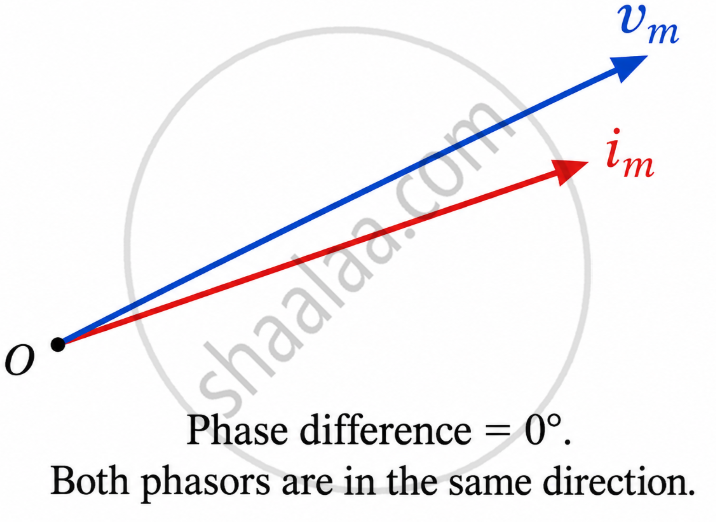
Key Result: For a pure resistor, the voltage and current phasors are always in the same direction. The phase angle between them is zero (0°).
This means:
- Current and voltage are in phase
- Both reach their peak, zero, and minimum at the same instant
- The voltage and current phasors coincide on the phasor diagram
CBSE: Class 12
Key Points: Phasors
- A phasor is a rotating vector about the origin with angular speed ω.
- Its vertical component gives the instantaneous value of v or i.
- The length of the phasor equals the peak value (vm or im).
- For a pure resistor: current and voltage are in phase — phasors point in the same direction, phase angle = 0°.
- For inductors, capacitors, or combinations: the current is NOT in phase with voltage — phasors differ in direction.