Topics
Rotational Dynamics
- Rotational Dynamics
- Circular Motion and Its Characteristics
- Applications of Uniform Circular Motion
- Vertical Circular Motion
- Moment of Inertia as an Analogous Quantity for Mass
- Radius of Gyration
- Theorems of Perpendicular and Parallel Axes
- Angular Momentum or Moment of Linear Momentum
- Expression for Torque in Terms of Moment of Inertia
- Conservation of Angular Momentum
- Rolling Motion
- Overview: Rotational Dynamics
Circular Motion
- Angular Displacement
- Angular Velocity
- Angular Acceleration
- Angular Velocity and Its Relation with Linear Velocity
- Uniform Circular Motion (UCM)
- Radial Acceleration
- Dynamics of Uniform Circular Motion - Centripetal Force
- Centrifugal Forces
- Banking of Roads
- Vertical Circular Motion Due to Earth’s Gravitation
- Equation for Velocity and Energy at Different Positions of Vertical Circular Motion
- Kinematical Equations for Circular Motion in Analogy with Linear Motion.
Gravitation
- Newton’s Law of Gravitation
- Periodic Time
- Kepler’s Laws
- Binding Energy and Escape Velocity of a Satellite
- Weightlessness
- Variation of ‘G’ Due to Lattitude and Motion
- Variation in the Acceleration>Variation in Gravity with Altitude
- Communication satellite and its uses
- Composition of Two S.H.M.’S Having Same Period and Along Same Line
Mechanical Properties of Fluids
- Fluid and Its Properties
- Thrust and Pressure
- Pressure of liquid
- Pressure Exerted by a Liquid Column
- Atmospheric Pressure
- Gauge Pressure and Absolute Pressure
- Hydrostatic Paradox
- Pascal’s Law
- Application of Pascal’s Law
- Measurement of Atmospheric Pressure
- Mercury Barometer (Simple Barometer)
- Open Tube Manometer
- Surface Tension
- Molecular Theory of Surface Tension
- Surface Tension and Surface Energy
- Angle of Contact
- Effect of Impurity and Temperature on Surface Tension
- Excess Pressure Across the Free Surface of a Liquid
- Explanation of Formation of Drops and Bubbles
- Capillarity and Capillary Action
- Fluids in Motion
- Critical Velocity and Reynolds Number
- Viscous Force or Viscosity
- Stokes’ Law
- Terminal Velocity
- Continuous and Discontinuous Functions
- Bernoulli's Equation
- Applications of Bernoulli’s Equation
- Overview: Mechanical Properties of Fluids
Kinetic Theory of Gases and Radiation
- Gases and Its Characteristics
- Classification of Gases: Real Gases and Ideal Gases
- Mean Free Path
- Expression for Pressure Exerted by a Gas
- Root Mean Square (RMS) Speed
- Interpretation of Temperature in Kinetic Theory
- Law of Equipartition of Energy
- Specific Heat Capacity
- Absorption, Reflection, and Transmission of Heat Radiation
- Perfect Blackbody
- Emission of Heat Radiation
- Kirchhoff’s Law of Heat Radiation and Its Theoretical Proof
- Spectral Distribution of Blackbody Radiation
- Wien's Displacement Law
- Stefan-boltzmann Law of Radiation
- Overview: Kinetic Theory of Gases and Radiation
Angular Momentum
- Definition of M.I., K.E. of Rotating Body
- Rolling Motion
- Physical Significance of M.I (Moment of Inertia)
- Torque and Angular Momentum
- Theorems of Perpendicular and Parallel Axes
- M.I. of Some Regular Shaped Bodies About Specific Axes
Oscillations
- Periodic and Oscillatory Motion
- Simple Harmonic Motion (S.H.M.)
- Differential Equation of Linear S.H.M.
- Projection of U.C.M.(Uniform Circular Motion) on Any Diameter
- Phase of K.E (Kinetic Energy)
- K.E.(Kinetic Energy) and P.E.(Potential Energy) in S.H.M.
- Composition of Two S.H.M.’S Having Same Period and Along Same Line
- Some Systems Executing Simple Harmonic Motion
Thermodynamics
- Thermodynamics
- Thermal Equilibrium
- Measurement of Temperature
- Heat, Internal Energy and Work
- First Law of Thermodynamics
- Thermodynamic State Variables and Equation of State
- Thermodynamic Process
- Heat Engine
- Refrigerators and Heat Pumps
- Entropy and Second Law of Thermodynamics
- Carnot Cycle and Carnot Engine
- Overview: Thermodynamics
Elasticity
- Eneral Explanation of Elastic Property
- Stress and Strain
- Hooke’s Law
- Elastic Energy
- Elastic Constants and Their Relation
- Determination of ‘Y’
- Behaviour of Metal Wire Under Increasing Load
- Application of Elastic Behaviour of Materials
Oscillations
- Oscillations
- Explanation of Periodic Motion
- Linear Simple Harmonic Motion (S.H.M.)
- Differential Equation of Linear S.H.M.
- Acceleration (a), Velocity (v) and Displacement (x) of S.H.M.
- Amplitude (A), Period (T) and Frequency (N) of S.H.M.
- Reference Circle Method
- Phase in S.H.M.
- Graphical Representation of S.H.M.
- Composition of Two S.H.M.’S Having Same Period and Along Same Line
- The Energy of a Particle Performing S.H.M.
- Simple Pendulum
- Angular S.H.M. and It's Differential Equation
- Damped Oscillations
- Free Oscillations, Forced Oscillations and Resonance Oscillations
- Periodic and Oscillatory Motion
- Overview: Oscillations
Superposition of Waves
Surface Tension
- Molecular Theory of Surface Tension
- Surface Tension
- Capillarity and Capillary Action
- Effect of Impurity and Temperature on Surface Tension
Wave Optics
- Introduction to Wave Optics
- Nature of Light
- Light as a Wave
- Huygens Principle
- Reflection of Light from Plane Surfaces: Plane Mirror
- Refraction of Light at a Plane Boundary Between Two Media
- Polarisation of Light
- Interference
- Diffraction of Light
- Resolving Power of Optical Instruments
- Overview: Wave Optics
Wave Motion
- Wave Motion Introduction
- Simple Harmonic Progressive Waves,
- Reflection of Transverse and Longitudinal Waves
- Change of Phase
- Principle of Superposition of Waves
- Formation of Beats
- Beats
Electrostatics
- Concept of Electrostatics
- Application of Gauss' Law
- Electric Potential and Potential Difference
- Electric Potential Due to a Point Charge
- Equipotential Surfaces
- Electrical Energy of Two Point Charges and of a Dipole in an Electrostatic Field
- Free and Bound Charges
- Combination of Capacitors
- Displacement Current
- Energy Stored in a Charged Capacitor
- Van De Graaff Generator
- Uniformly Charged Infinite Plane Sheet and Uniformly Charged Thin Spherical Shell (Field Inside and Outside)
- Overview: Electrostatics
Stationary Waves
- Study of Vibrations in a Finite Medium
- Formation of Stationary Waves on String
- Study of Vibrations of Air Columns
- Free and Forced Vibrations
- Forced Oscillations and Resonance
Kinetic Theory of Gases and Radiation
- Concept of an Ideal Gas
- Assumptions of Kinetic Theory of Gases
- Derivation for Pressure of a Gas
- Degrees of Freedom
- Derivation of Boyle’s Law
- Thermal Equilibrium
- First Law of Thermodynamics
- Heat Engine
- Temperature and Heat
- Qualitative Ideas of Black Body Radiation
- Wien's Displacement Law
- Green House Effect
- Stefan's Law
- Maxwell Distribution
- Specific Heat Capacities - Gases
- Law of Equipartition of Energy
Current Electricity
Wave Theory of Light
Magnetic Fields Due to Electric Current
- Magnetic Fields Due to Electric Current
- Magnetic force
- Cyclotron
- Helical Motion
- Magnetic Force on a Wire Carrying a Current
- Force on a Closed Circuit in a Magnetic Field
- Torque on a Current-Loop in a Uniform Magnetic Field
- Magnetic Dipole Moment
- Magnetic Potential Energy of a Dipole
- Magnetic Field Due to a Current-carrying Conductor: Biot-savart's Law
- Force of Attraction Between Two Long Parallel Wires
- Magnetic Field Produced by a Current in a Circular Arc of a Wire
- Applications of Biot-Savart's Law > Magnetic Field at the Axis of a Circular Current-carrying Loop
- Magnetic Lines for a Current Loop
- Ampere’s Circuital Law
- Applications of Ampere’s Circuital Law > Magnetic Field of a Toroidal Solenoid
- Overview: Magnetic Fields Due to Electric Current
Magnetic Materials
- Selection of Magnetic Materials
- Torque Acting on a Magnetic Dipole in a Uniform Magnetic Field
- Origin of Magnetism in Materials
- Magnetisation and Magnetic Intensity
- Magnetic Properties of Materials
- Classification of Magnetic Materials
- Hysteresis: Retentivity and Coercivity
- Permanent Magnet
- Magnetic Shielding
- Overview: Magnetic Materials
Interference and Diffraction
- Interference of Light
- Conditions for Producing Steady Interference Pattern
- Interference of Light Waves and Young’s Experiment
- Analytical Treatment of Interference Bands
- Measurement of Wavelength by Biprism Experiment
- Fraunhofer's Diffraction Due to a Single-slit
- Rayleigh’s Criterion
- Resolving Power of a Microscope and Telescope
- Interference Vs Diffraction
Electromagnetic Induction
- Introduction to Electromagnetic Induction
- Faraday's Laws of Electromagnetic Induction
- Lenz's Law
- Flux of a Vector Field
- Motional Electromotive Force (e.m.f.)
- Induced Emf in a Stationary Coil in a Changing Magnetic Field
- Generators
- Back Emf and Back Torque
- Induction and Energy Transfer
- Eddy Currents or Foucault Currents
- Self Inductance
- Energy Stored in a Magnetic Field
- Energy Density of a Magnetic Field
- Mutual Inductance
- Transformers
- Overview of Electromagnetic Induction
Electrostatics
- Mechanical Force on Unit Area of a Charged Conductor
- Energy Density of a Medium
- Concept of Condenser
- The Parallel Plate Capacitor
- Capacity of Parallel Plate Condenser
- Effect of Dielectric on Capacitance
- Energy of Charged Condenser
- Condensers in Series and Parallel,
- Van-deGraaff Generator
Current Electricity
- Meter Bridge
AC Circuits
- Introduction to Ac and Aс Circuits
- Values of Alternating Current
- Phasors
- AC Voltage Applied to a Resistor
- AC Voltage Applied to an Inductor
- AC Voltage Applied to a Capacitor
- AC Voltage Applied to a Series LCR Circuit
- Power in AC Circuit
- LC Oscillations
- Electric Resonance
- Sharpness of Resonance: Q Factor
- Choke Coil
- Overview: AC Circuits
Dual Nature of Radiation and Matter
Magnetic Effects of Electric Current
Magnetism
Structure of Atoms and Nuclei
- Structure of the Atom and Nucleus
- Thomson’s Atomic Model
- Geiger-marsden Experiment
- Rutherford’s Atomic Model
- Atomic Spectra
- Neils Bohr’s Model of an Atom
- Atomic Nucleus
- Constituents of a Nucleus
- Isotopes
- Atomic and Nuclear Masses
- Size of the Nucleus
- Mass Defect and Binding Energy
- Binding Energy Curve
- Forms of Energy > Nuclear Energy
- Nuclear Binding Energy
- Radioactive Decays
- Law of Radioactive Decay
- Overview: Structure of Atoms and Nuclei
Semiconductor Devices
Electromagnetic Inductions
- Introduction to Electromagnetic Induction
- Self Inductance
- Mutual Inductance
- Transformers
- Need for Displacement Current
- Coil Rotating in Uniform Magnetic Induction
- Alternating-Current Generator
- Reactance and Impedance
- LC Oscillations
- Inductance and Capacitance
- Resonant Circuits
- Power in AC Circuit
- Lenz’s Law and Conservation of Energy
Electrons and Photons
Atoms, Molecules and Nuclei
- Alpha-particle Scattering and Rutherford’s Nuclear Model of Atom
- Bohr’s Model for Hydrogen Atom
- Hydrogen Spectrum
- Atomic Masses and Composition of Nucleus
- Radioactivity
- Law of Radioactive Decay
- Atomic Mass, Mass - Energy Relation and Mass Defect
- Nuclear Binding Energy
- Nuclear Fusion
- de-Broglie Relation
- Wave Nature of Matter
- Wavelength of an Electron
- Davisson and Germer Experiment
- Continuous and Characteristics X-rays
- Mass Defect and Binding Energy
Semiconductors
- Energy Bands in Materials
- Extrinsic Semiconductor
- Applications of n-type and p-type Semiconductors
- Special Purpose P-n Junction Diodes
- Semiconductor Diode
- Voltage Regulator
- I-V Characteristics of Led
- Transistor and Characteristics of a Transistor
- Transistor as an Amplifier (Ce-configuration)
- Transistor as a Switch
- Oscillators
- Digital Electronics and Logic Gates
Communication Systems
The 5-Step Method to Apply Gauss's Law
Follow this procedure for every application:
- Identify the symmetry of the charge distribution (spherical / cylindrical / planar)
- Choose the Gaussian surface that matches the symmetry
- Evaluate the flux Φ = E ⋅ A (since \[\vec E\] ∥ d\[\vec A\] on the chosen surface)
- Find the enclosed charge Qenc
- Apply Gauss's Law E ⋅ A = Qenc/ε0 and solve for E
Symmetry → Gaussian Surface Map
| Symmetry Type | Example | Gaussian Surface |
|---|---|---|
| Cylindrical | Infinite line charge | Coaxial cylinder |
| Planar | Infinite plane sheet / Conducting plate | Rectangular pillbox |
| Spherical | Spherical shell / Solid sphere | Concentric sphere |
Case 1 — Electric Field Due to an Infinite Line Charge
Setup
- Infinitely long, straight wire with uniform linear charge density λ (C/m)
- Find E at a perpendicular distance r from the wire
Gaussian Surface
- Coaxial cylinder of radius r and length l
- Flux through flat ends = 0 (since \[\vec E\] ⊥ d\[\vec A\] at ends)
- Flux through curved surface = E ⋅ (2πrl)
Derivation Outline
Qenc = λl
Φ = E ⋅ 2πrl = \[\frac {λl}{ε_0}\]
✦ Result
E = \[\frac {λ}{2πε_0r}\]
Key Points
- E ∝ \[\frac {1}{r}\] (decreases as distance increases)
- Direction: radially outward for positive λ; radially inward for negative λ
- λ = linear charge density; SI unit = C/m
Case 2 — Electric Field Due to an Infinite Plane Sheet
Setup
- Uniformly charged thin insulating infinite plane sheet
- Surface charge density σ (C/m²); same on both sides
Gaussian Surface
- Rectangular pillbox (cylinder) straddling the sheet
- Flux through curved side wall = 0 (since \[\vec E\] || sheet surface)
- Flux through two flat faces (each area A) = 2EA
Derivation Outline
Qenc = σA
2EA = \[\frac {σA}{ε_0}\]
✦ Result
E = \[\frac {σ}{2ε_0}\]
Key Points
- E is uniform and independent of distance from the sheet
- Direction: perpendicular to the sheet (outward for +σ, inward for −σ)
- Valid only for an ideal infinite insulating sheet
Case 3 — Electric Field Due to a Charged Conducting Plate
Setup
- A single conducting plate with surface charge density σ on its outer surface only
Key Difference from Insulating Sheet
The pillbox Gaussian surface here has flux only through one face (the field is zero inside a conductor):
EA = \[\frac {σA}{ε_0}\]
✦ Result
E = \[ \dfrac{\sigma}{\varepsilon_0} \]
"Why is the conducting plate formula different from the insulating sheet?"
- Insulating sheet: charge is on both surfaces → flux exits from both faces → divide by 2 → E = σ/2ε0
- Conducting plate: charge resides only on outer surface; field is zero inside the conductor → flux exits from one face only → E = σ/ε0
Case 4 — Electric Field Due to a Uniformly Charged Thin Spherical Shell
Setup
-
Thin shell of radius R, total charge Q, surface charge density σ
Gaussian Surface
-
Concentric spherical surface of radius r
Sub-case A: Outside the Shell (r > R)
E ⋅ 4πr2 = \[\frac {Q}{ε_0}\]
E = \[\frac {Q}{4πε_0r^2}\] = \[\frac {σR^2}{ε_0r^2}\]
The shell behaves as a point charge at its centre for external points.
Sub-case B: On the Surface (r = R)
E = \[\frac {Q}{4πε_0R^2}\] = \[\frac {σ}{ε_0}\]
Sub-case C: Inside the Shell (r < R)
The Gaussian surface encloses zero charge → Qenc = 0
E = 0
Analogy: Think of the shell like a hollow coconut. Anywhere outside, the whole coconut "feels" like one concentrated point. But inside the hollow shell, there is complete shielding — no electric field at all.
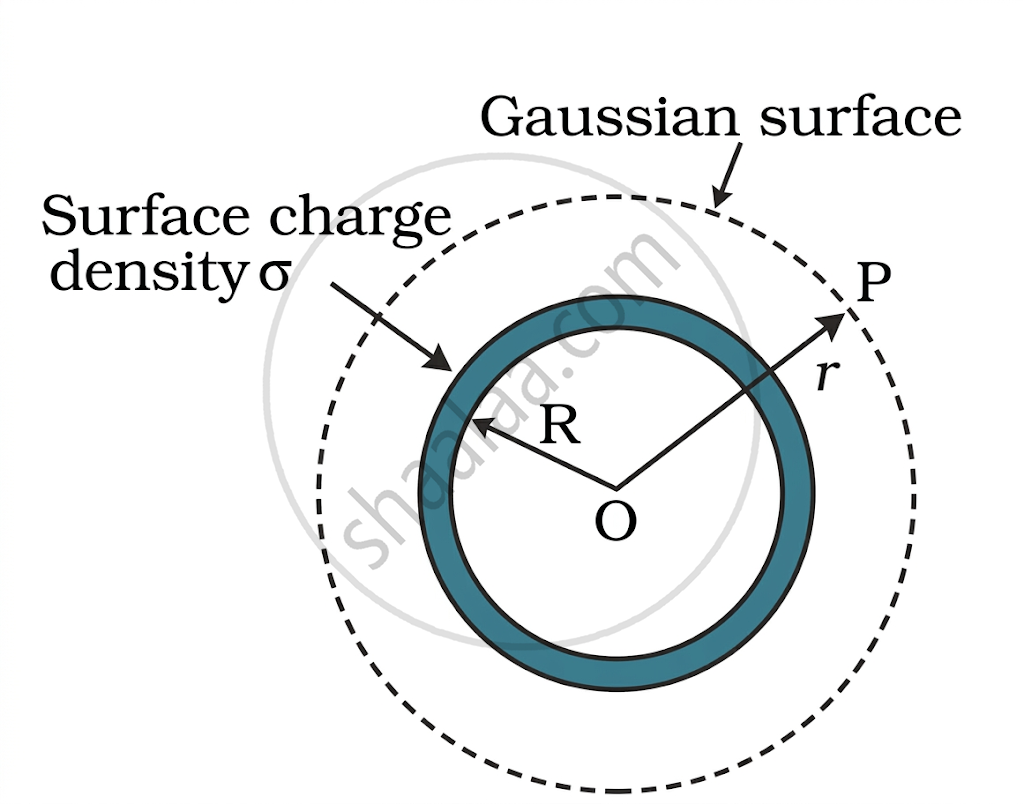
(a)
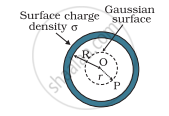
(b)
Case 5 — Solid Non-Conducting Uniformly Charged Sphere
Radius R, total charge Q, volume charge density ρ
Outside (r > R)
E = \[\frac {Q}{4πε_0r^2}\]
Inside (r < R)
Qenc = \[\frac {4}{3}\]πr3 ρ = Q ⋅ \[\frac {r^3}{R^3}\]
E = \[\frac {Qr}{4πε_0R^3}\] ∝ r
