Topics
Electric Charges and Fields
- Electric Charges
- Conductors and Insulators
- Properties of Electric Charge
- Coulomb’s Law
- Forces between Multiple Charges
- Electric Field
- Electric Field Due to a System of Charges
- Physical Significance of Electric Field
- Electric Field Lines
- Electric Flux
- Electric Dipole
- Dipole in a Uniform External Field
- Continuous Charge Distribution
- Gauss’s Law
- Application of Gauss' Law
Electrostatics
Current Electricity
Electrostatic Potential and Capacitance
- Electric Potential and Potential Energy
- Electrostatic Potential
- Electric Potential Due to a Point Charge
- Potential Due to an Electric Dipole
- Potential due to a System of Charges
- Equipotential Surfaces
- Relation Between Electric Field and Electrostatic Potential
- Potential Energy of a System of Charges
- Potential Energy of a Single Charge
- Potential Energy of a System of Two Charges in an External Field
- Potential Energy of a Dipole in an External Field
- Electrostatics of Conductors
- Dielectrics and Polarisation
- Capacitors and Capacitance
- The Parallel Plate Capacitor
- Effect of Dielectric on Capacitance
- Combination of Capacitors
- Energy Stored in a Charged Capacitor
Magnetic Effects of Current and Magnetism
Current Electricity
- Electric Current
- Electric Currents in Conductors
- Ohm's Law
- Drift of Electrons and the Origin of Resistivity
- Mobility of Electrons
- Limitations of Ohm’s Law
- Resistivity of Various Materials
- Temperature Dependence of Resistivity
- Electrical Energy and Power in Conductors
- Cells, EMF, and Internal Resistance
- Cells in Series and in Parallel
- Kirchhoff’s Laws
- Wheatstone Bridge
Moving Charges and Magnetism
- Electromagnetism
- Magnetic force
- Motion in a Magnetic Field
- Magnetic Field Due to a Current-carrying Conductor: Biot-savart's Law
- Applications of Biot-Savart's Law > Magnetic Field at the Axis of a Circular Current-carrying Loop
- Ampere’s Circuital Law
- Solenoid
- Force Between Two Parallel Currents (Ampere’s Law)
- Torque on a Rectangular Current Loop in a Uniform Magnetic Field
- Circular Current Loop as a Magnetic Dipole
- Moving Coil Galvanometer
- Kirchhoff’s Laws
Electromagnetic Induction and Alternating Currents
Magnetism and Matter
Electromagnetic Waves
Optics
Electromagnetic Induction
Alternating Current
Dual Nature of Radiation and Matter
Electromagnetic Waves
Atoms and Nuclei
Electronic Devices
Ray Optics and Optical Instruments
- Ray Optics Or Geometrical Optics
- Reflection of Light by Spherical Mirrors
- Sign Convention for Reflection by Spherical Mirrors
- Focal Length of Spherical Mirrors
- Mirror Equation of Spherical Mirrors
- Refraction of Light
- Total Internal Reflection
- Applications of Total Internal Reflection
- Refraction at a Spherical Surfaces
- Refraction by a Lens
- Power of a Lens
- Combined Focal Length of Two Thin Lenses in Contact
- Refraction of Light through a Prism
- Introduction to Optical Instruments
- Microscope and it’s types
- Telescope
Communication Systems
Wave Optics
- Introduction to Wave Optics
- Huygens Principle
- Refraction of a Plane Wave
- Refraction at a Rarer Medium
- Reflection of a Plane Wave by a Plane Surface
- Coherent and Incoherent Addition of Waves
- Interference of Light Waves and Young’s Experiment
- Diffraction of Light
- The Single Slit
- Seeing the Single Slit Diffraction Pattern
- Polarisation of Light
Dual Nature of Radiation and Matter
- Understanding Dual Nature of Radiation and Matter
- Electron Emission
- Photoelectric Effect - Hertz’s Observations
- Photoelectric Effect - Hallwachs’ and Lenard’s Observations
- Experimental Study of Photoelectric Effect
- Effects of Intensity and Frequency on Photocurrent
- Photoelectric Effect and Wave Theory of Light
- Einstein’s Photoelectric Equation: Energy Quantum of Radiation
- Particle Nature of Light: The Photon
- Wave Nature of Matter
The Special Theory of Relativity
Atoms
Nuclei
Semiconductor Electronics - Materials, Devices and Simple Circuits
Communication Systems
- Detection of Amplitude Modulated Wave
- Production of Amplitude Modulated Wave
- Basic Terminology Used in Electronic Communication Systems
- Sinusoidal Waves
- Modulation and Its Necessity
- Amplitude Modulation (AM)
- Need for Modulation and Demodulation
- Satellite Communication
- Propagation of EM Waves
- Bandwidth of Transmission Medium
- Bandwidth of Signals
The Special Theory of Relativity
- The Special Theory of Relativity
- The Principle of Relativity
- Maxwell'S Laws
- Kinematical Consequences
- Dynamics at Large Velocity
- Energy and Momentum
- The Ultimate Speed
- Twin Paradox
Estimated time: 6 minutes
CBSE: Class 12
Introduction
Inside the atom, electrons are held by electrostatic attraction, but the nucleus contains positively charged protons packed into a very small space. Since protons repel one another, a much stronger attractive force must exist to hold the nucleus together.
CBSE: Class 12
Definition: Nuclear Force
The nuclear force is the strong attractive force between nucleons (protons and neutrons) that binds them together inside the nucleus.
CBSE: Class 12
Nuclear Force
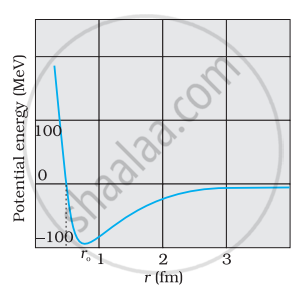
- The binding energy per nucleon in nuclei is about 8 MeV, which is far larger than the binding energy per nucleon in ordinary atoms.
- Therefore, the force that binds nucleons cannot be the same as the force responsible for ordinary atomic structure.
- This special attractive force acting between nucleons is called the nuclear force.
- It acts between proton-proton, neutron-neutron, and proton-neutron pairs.
- It is effective only over very small distances inside the nucleus.
- It is responsible for the stability of nuclei.
CBSE: Class 12
Properties of Nuclear Force
Very Strong Force
- The nuclear force is much stronger than the gravitational force.
- Inside the nucleus, the strong force is strong enough to overcome the electrostatic repulsion between protons.
- This is why nucleons can remain bound within a tiny nuclear volume.
Short-Range Force
- The nuclear force acts only over a very short distance.
- Its effect falls rapidly to zero beyond a few femtometres.
- Because of this short range, a nucleon mainly interacts with its nearby nucleons.
Saturation Property
- Since each nucleon interacts strongly only with neighbouring nucleons, the nuclear force shows saturation.
- This explains why the binding energy per nucleon remains nearly constant for many medium and heavy nuclei.
Charge Independence
- The nuclear force is nearly the same for neutron-neutron, proton-neutron, and proton-proton pairs.
- Therefore, it does not depend on the electric charge of the nucleons.
Repulsive at Extremely Small Distance
- The potential energy curve for two nucleons shows a minimum at about r0 ≈ 0.8 fm.
- For separations larger than r0, the force is attractive, helping to bind nucleons.
- For separations smaller than r0, the force becomes strongly repulsive.
No Simple Mathematical Law
-
Unlike Coulomb's law or Newton's law of gravitation, the nuclear force does not have a simple universal mathematical expression.
