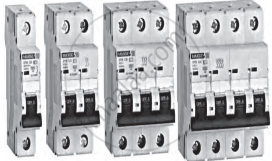
- Heating Effect: Current through a resistor produces heat, calculated by H = I²Rt or H = VIt (Joule’s Law).
- Heat Applications: Used in devices like irons, heaters, bulbs, and fuses (to stop excess current).
- Power Unit: 1 kWh = 3.6 × 10⁶ J, called 1 unit of electrical energy in electricity bills.
- Short Circuit & Fuse: A short circuit causes a large current; the fuse wire melts to break the circuit and prevent fire.
- MCBs: Miniature Circuit Breakers automatically cut off power during overload or fault conditions.
Topics
Chemical Substances-Nature and Behaviour
Chemical Reactions and Equations
- Chemical Reaction
- Characteristics of Chemical Reactions
- Chemical Equations
- Balanced and Unbalanced Chemical Equations
- Balancing Chemical Equation
- Types of Chemical Reactions > Combination Reaction
- Types of Chemical Reactions > Decomposition Reaction
- Types of Chemical Reactions > Single Displacement Reaction
- Types of Chemical Reactions > Double Displacement Reaction
- Types of Chemical Reactions > Reversible and Irreversible Reactions
- Types of Chemical Reactions > Oxidation and Reduction Reactions
- Corrosion of Metals
- Rancidity
World of Living
Acids, Bases and Salts
- Introduction to Acids, Bases and Indicators
- Indicators for Testing Acids and Bases
- Acids
- Properties of Acids
- Common Properties of Acids
- Uses of Acids
- Bases
- Properties of Bases
- Uses of Bases
- Chemical Properties of Acids and Bases
- Common Properties of Acids and Bases
- Strength of Acid and Base Solutions : pH Scale
- Universal Indicator
- Importance of pH in Everyday Life
- Salts
- Salts > Family of Salts
- Salts > pH of Salts
- Common Salt
- Sodium hydroxide
- Washing Soda
- Baking Soda
- Bleaching Powder
- Plaster of Paris
- Water of Crystallisation: Hydrated Salts
Natural Phenomena
Metals and Non-metals
Carbon and its Compounds
Effects of Current
Life Processes
Natural Resources
Control and Coordination
How do Organisms Reproduce?
- DNA Copying and Variation
- The Importance of Variation
- Reproduction
- Modes of Reproduction
- Asexual Reproduction
- Asexual Reproduction in Unicellular Organisms > Binary Fission
- Binary Fission > Simple Binary Fission
- Binary Fission > Longitudinal Binary Fission
- Binary Fission > Transverse Binary Fission
- Asexual Reproduction in Unicellular Organisms > Multiple Fission
- Asexual Reproduction in Multicellular Organisms > Fragmentation
- Asexual Reproduction in Multicellular Organisms > Regeneration
- Asexual Reproduction in Unicellular Organisms > Budding
- Asexual Reproduction in Multicellular Organisms > Budding
- Asexual Reproduction in Multicellular Organisms > Spore Formation
- Vegetative Reproduction or Vegetative Propagation
- Natural Vegetative Propagation
- Artificial Vegetative Propagation
- Tissue Culture
- Sexual Reproduction
- Sexual Reproduction in Plants
- Pollination
- Self-pollination
- Cross-pollination
- Fertilisation in Flowering Plants
- Formation of Seed and Fruit
- Seed Germination
- Sexual Reproduction in Animals
- Puberty
- The Male Reproductive System
- The Female Reproductive System
- Fertilization in Humans
- Menstrual Cycle (Ovarian Cycle)
- Major Events of Menstrual Cycle
- Menarche and Menopause
- Birth Control
- Natural Contraceptive Methods
- Artificial Contraceptive Methods
- Induced Abortion or Medical Termination of Pregnancy (MTP)
- Sexually Transmitted Diseases (STD) or Sexually Transmitted Infections (STI)
- Concept of Reproductive Health
Heredity
- Heredity
- Variation
- Accumulation of Variation During Reproduction
- Gregor Johann Mendel – Father of Genetics
- Monohybrid Cross
- Dihybrid Cross
- Characteristics (or Traits) Transmitted to Progeny
- Inheritance of Blood Groups
- Sex Determination in Humans
- Acquired and Inherited Traits
Light – Reflection and Refraction
- Nature of Light
- Reflection of Light
- Reflection of Light from Plane Surfaces: Plane Mirror
- Law of Reflection of Light
- Regular Reflection and Diffuse Reflection of Light
- Objects and Images
- Images Formed by a Plane Mirrors
- The Position of Image Formed in a Plane Mirror
- Uses of Plane Mirrors
- Spherical Mirrors
- Image Formation by Spherical Mirrors
- Rules for Obtaining Images Formed by Concave Mirrors
- Formation of Different Types of Images by a Concave Mirror
- Representation of Images Formed by Spherical Mirrors Using Ray Diagrams
- Sign Convention for Reflection by Spherical Mirrors
- Mirror Formula and Magnification
- Rules for Obtaining Images Formed by Convex Mirrors
- Formation of Image by a Convex Mirror
- Refraction of Light
- Effects of Refraction of Light
- Laws of Refraction of Light
- Refraction through a Rectangular Glass Slab
- The Refractive Index
- Refraction by Spherical Lenses
- Rules for Obtaining Images Formed by Convex Lenses
- Formation of Different Types of Images by a Convex Lens
- Image Formation by Lenses
- Image Formation in Lenses Using Ray Diagrams
- Sign Convention for Reflection by Spherical Mirrors
- Lens Formula and Magnification
- Lens Formula and Magnification Formulae for a Concave Lens
- Power of a Lens
The Human Eye and the Colourful World
- Human Eye
- Working of the Eye
- Rods and Cones
- Power of Accommodation
- Range of Vision of a Normal Human Eye
- Advantages of Having Two Eyes for Vision
- Defects of Vision and Their Corrections > Myopia
- Defects of Vision and Their Corrections > Hypermetropia
- Defects of Vision and Their Corrections > Presbyopia
- Glass Prism
- Refraction of Light through a Prism
- Dispersion of Light Through a Prism
- The Rainbow
- Atmospheric Refraction
- Scattering of Light
Electricity
- Electric Charges
- Conductors and Insulators
- Electric Potential and Potential Difference
- Electric Current
- Electric Circuit
- Circuit Diagram
- Ohm's Law
- Resistance of a Conductor
- Graph Between V and I
- Experiment to Verify Ohm's Law
- Good Conductors, Resistors and Insulators
- Factors Affecting the Resistance of a Conductor
- Resistivity
- Resistance of a System of Resistors
- Resistors in Series
- Resistors in Parallel
- Domestic Electric Circuits
- Heating Effect of Electric Current
- Practical Applications of Heating Effect of Electric Current
- Electric Power
- Commercial Unit of Electrical Energy
- Effects Produced by Electric Current
- Applications of the Heating Effect of Current
Magnetic Effects of Electric Current
- Introduction to Magnets and Their Properties
- Electromagnetism
- Magnetic Field and Field Lines
- Magnetic Field of Earth
- Magnetic Effect of Current (or Electromagnetism)
- Magnetic Field Due to a Current-Carrying Conductor
- Magnetic Field due to a Current through a Straight Conductor
- Right-hand Thumb Rule
- Magnetic Field due to a Current through a Circular Loop
- Magnetic Field due to a Current in a Solenoid
- Electromagnet
- Magnetism in Human Beings
- Force on a Current-Carrying Conductor in a Magnetic Field
- Domestic Electric Circuits
Our Environment
Maharashtra State Board: Class 10
Introduction
The heating effect of electric current refers to the generation of heat when an electric current flows through a conductor. This effect is widely used in various devices and appliances, such as electric heaters, bulbs, and irons, to perform useful tasks.
How it Works:
When an electric current passes through a conductor (like a wire), the electrons collide with the atoms of the conductor. This collision causes the atoms to vibrate, which generates heat. The amount of heat produced depends on the current, the resistance of the conductor, and the duration of current flow.
Maharashtra State Board: Class 10
Joule’s Law of Heating
Joule’s Law explains the relationship between the heat produced and the factors involved. The law states that the amount of heat produced (H) is directly proportional to
- The square of the current (I²)
- The resistance of the conductor (R)
- The time (t) the current flows.
Mathematically, this is expressed as : H = I²Rt
Where:
- H = Heat produced (in Joules)
- I = Electric current (in Amperes)
- R = Resistance of the conductor (in Ohms)
- t = Time (in seconds)
Maharashtra State Board: Class 10
Applications:
- Electric Bulbs: In an electric bulb, a tungsten filament is used. When current flows through the filament, it gets heated to a high temperature (up to 3400°C), emitting both light and heat. The heating effect of the current in the filament is what makes the bulb glow.
- Electric Heaters: Electric heaters make use of the heating effect by passing current through a resistive coil (usually made of Nichrome). This coil heats up and is used to heat water or air.
- Electric Irons: The heating element in an electric iron is designed to get hot when the current passes through it. This heat is used to press clothes.
- Toasters and Electric Cookers: Similar to electric heaters, these appliances use coils with high resistance. The current passing through these coils generates heat, which is used for cooking or heating food.

Uses of coil
Maharashtra State Board: Class 10
Units of Power and Energy
The electric power is measured in watts (W), where 1 W is a small unit. In practice, we often use kilowatts (kW) to measure power.
- 1 kW = 1000 W
- If 1 kW of power is used for 1 hour, it will consume 1 kWh of energy, which is equal to:
- 1 kWh = 1 kW × 1 hr = 1000 W × 3600 s = 3.6 × 10⁶ J (Joules)
Maharashtra State Board: Class 10
Safety Measures and Overloading:
The heating effect of electric current can be dangerous if the current exceeds safe limits. Overloading a circuit or a device can cause the wires or equipment to overheat, leading to fire hazards or damage to the electrical components.
- Short Circuits: A short circuit occurs when the live and neutral wires touch, causing a large current to flow, generating excessive heat. This can cause fires if inflammable materials are nearby.
- Fuse Wire: To prevent damage from excessive current, a fuse wire is used in electrical circuits. If the current exceeds the safe limit, the fuse wire melts and breaks the circuit, stopping the current flow and preventing further damage or fire.
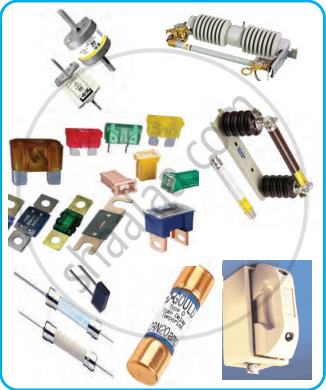
- Miniature Circuit Breakers (MCBs): In modern electrical systems, MCBs are used instead of fuse wires. They automatically cut off the current if it exceeds the safe limit, providing better protection against overheating and overloading.
Overloading and Power Surges:
Overloading occurs when too many electrical devices are used at once, drawing excessive current from the transformer. If the transformer cannot handle the load, the fuse in the transformer melts, shutting down the supply to prevent damage.
Maharashtra State Board: Class 10
Definition: Heating effect of electric current
When a resistor is connected in an electrical circuit, heat is produced in it due to the current. This is known as the heating effect of current.
CBSE: Class 10
Maharashtra State Board: Class 10
Maharashtra State Board: Class 10
Key Points: Heating Effect of Electric Current
Shaalaa.com | Electricity part 11 (Heating effect of current)
to track your progress
