Advertisements
Advertisements
प्रश्न
The current passing through an electric kettle has been doubled. The heat produced will become:
(a) half
(b) double
(c) four time
(d) one-fourth
Advertisements
उत्तर
(c) four times
Heat produced is directly proportional to the square of the current.
APPEARS IN
संबंधित प्रश्न
Compute the heat generated while transferring 96000 coulomb of charge in one hour through a potential difference of 50 V.
The safety device based on the heating effect of electric current is called a ______.
Explain why, the current that makes the heater element very hot, only slightly warms the connecting wires leading to the heater.
Name the factors on which the heat produced in a wire depends when current is passed in it, and state how does it depend on the factors stated by you.
A coil of an alloy _______ is used in electric heater cooker as a resistor.
Name any two appliances which work under the principle of heating effect of current.
Mark the correct choice
- Assertion: Electric appliances with a metallic body have three wire connections.
- Reason: Three-pin connections reduce the heating of the connecting wires.
A current of 1 A is drawn by a filament of an electric bulb. Number of electrons passing through a cross-section of the filament in 16 seconds would be roughly:
What is Joule’s heating effect? How can it be demonstrated experimentally? List its four applications in daily life.
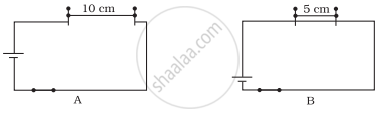
Paheli took a wire of length 10 cm. Boojho took a wire of 5 cm of the same material and thickness. Both of them connected the wires as shown in the circuit given in the following figure. The current flowing in both the circuits is the same.
- Will the heat produced in both cases be equal? Explain.
- Will the heat produced be the same if the wires taken by them are of equal lengths but of different thickness? Explain.
Explain the working of an electric fuse.
Copper wire offers very little ______ and does not get heated up quickly.
Assertion: A current-carrying wire should be charged.
Reason: The current in a wire is due to the flow of free electrons in a definite direction.
The following is not a safety device.
A fuse is used in an electric circuit to stop high currents flowing through the circuit.
Find the odd one out.
An electric kettle consumes 1 kW of electric power when operated at 220 V. A fuse wire of what rating must be used for it?
The graph of voltage vs current for four different materials is shown below.

Which of these four materials would be used for making filament of bulb?
