Advertisements
Advertisements
प्रश्न
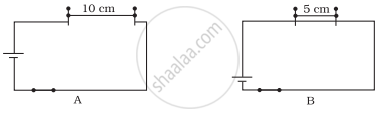
Paheli took a wire of length 10 cm. Boojho took a wire of 5 cm of the same material and thickness. Both of them connected the wires as shown in the circuit given in the following figure. The current flowing in both the circuits is the same.
- Will the heat produced in both cases be equal? Explain.
- Will the heat produced be the same if the wires taken by them are of equal lengths but of different thickness? Explain.
Advertisements
उत्तर
- No, the amount of heat produced in both cases will not be equal. The amount of heat produced in a wire depends upon the length of the wire.
- No, the amount of heat produced in the wire depends upon the thickness of the wire.
APPEARS IN
संबंधित प्रश्न
Why are the coils of electric irons and electric toasters made of an alloy rather than a pure metal?
Name the factors on which the heat produced in a wire depends when current is passed in it, and state how does it depend on the factors stated by you.
Rewrite the following statement by selecting the correct option:
1 A = ____________ mA.
Explain the importance/uses of fuse wire.
What is a trip switch?
A trip switch is a ______ safety device.
The electric fuse works on the Joule heating principle.
Explain why fuse wire is always connected in a series arrangement.
Define the following:
Electrolyte
If 220 V potential difference is applied across an electric bulb, a current of 0.45 A flows in the bulb. What must be the power of the bulb?
