Advertisements
Advertisements
प्रश्न
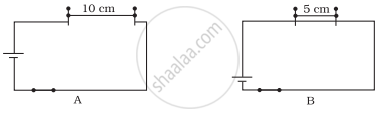
Paheli took a wire of length 10 cm. Boojho took a wire of 5 cm of the same material and thickness. Both of them connected the wires as shown in the circuit given in the following figure. The current flowing in both the circuits is the same.
- Will the heat produced in both cases be equal? Explain.
- Will the heat produced be the same if the wires taken by them are of equal lengths but of different thickness? Explain.
Advertisements
उत्तर
- No, the amount of heat produced in both cases will not be equal. The amount of heat produced in a wire depends upon the length of the wire.
- No, the amount of heat produced in the wire depends upon the thickness of the wire.
APPEARS IN
संबंधित प्रश्न
How does the resistance of a wire vary with its area of cross-section?
The elements of electrical heating devices are usually made of:
(a) tungsten
(b) bronze
(c) nichrome
(d) argon
How does the wire in the filament of a light bulb behave differently to the other wires in the circuit when the current flows?
What property of the filament wire accounts for this difference?
In an electric bulb, coil of _______ metal is used.
Explain the application of heating effect of electric current in an electric bulb with a diagram.
Mark the correct choice
- Assertion: Electric appliances with a metallic body have three wire connections.
- Reason: Three-pin connections reduce the heating of the connecting wires.
An electric iron consumes energy at the rate of 420 W when heating is at the maximum rate and 180 W when heating is at the minimum rate. The applied voltage is 220 V. What is the current in each case?
What are the uses of electromagnets?
An electric kettle of 2 kW is used for 2h. Calculate the energy consumed in
- kilowatt hour and
- joules.
State the law that explains the heating effect of current with respect to the measurable properties in an electrical circuit.
