Advertisements
Advertisements
Question
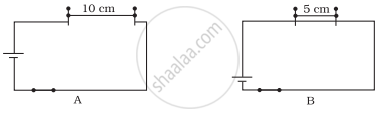
Paheli took a wire of length 10 cm. Boojho took a wire of 5 cm of the same material and thickness. Both of them connected the wires as shown in the circuit given in the following figure. The current flowing in both the circuits is the same.
- Will the heat produced in both cases be equal? Explain.
- Will the heat produced be the same if the wires taken by them are of equal lengths but of different thickness? Explain.
Advertisements
Solution
- No, the amount of heat produced in both cases will not be equal. The amount of heat produced in a wire depends upon the length of the wire.
- No, the amount of heat produced in the wire depends upon the thickness of the wire.
APPEARS IN
RELATED QUESTIONS
An electric iron of resistance 20 Ω takes a current of 5 A. Calculate the heat developed in 30 s.
Why is the tungsten used almost exclusively for filament of electric lamps?
The safety device based on the heating effect of electric current is called a ______.
Write down the formula for the heat produced when a current I is passed through a resistor R for time t.
What is meant by the heating effect of current?
Write the mathematical expression for Joule’s law of heating.
An electric iron consumes energy at the rate of 420 W when heating is at the maximum rate and 180 W when heating is at the minimum rate. The applied voltage is 220 V. What is the current in each case?
An electric iron draws a current of 4 A when connected to 220 V mains. Its resistance must be:
(a) Observe the diagram given below and state whether the bulb will glow or not when we switch on K.
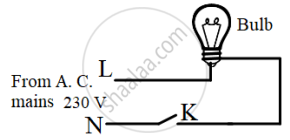
(b) Is it safe to handle the bulb when the switch is OFF?
(c) Give a reason for your answer in (b).
What are the uses of electromagnets?
