Advertisements
Advertisements
Question
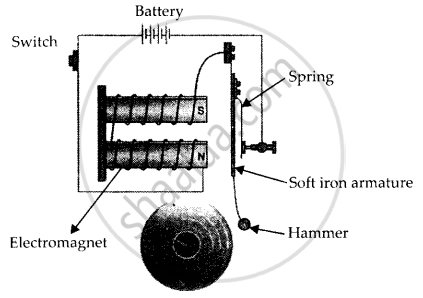
How does the magnetic effect of electric current help in the working of an electric bell? Explain with the help of a diagram.
Advertisements
Solution
The door bell or the electric bell makes use of the principle of an electromagnet. A horseshoe type of electromagnet is used in an electric bell which is connected to the source of current through a switch. It has a metallic gong, a hammer to strike the gong and screw attached to a soft iron strip.
When the button is pressed, the circuit is complete and the hammer gets attracted to the gong thereby striking it to produce a ringing sound.
APPEARS IN
RELATED QUESTIONS
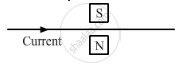
Which way does the wire in the diagram below tend to move?
How should the electric lamps in a building be connected so that the switching on or off in a room has no effect on other lamps in the same building?
What is the function of a split ring in an electric motor?
Observe the following diagram and choose the correct alternative:

Draw magnetic field lines produced around a straight current carrying conductor passing through a cardboard. How will the strength of the magnetic field change when the point where magnetic field is to be determined is moved away from the conductor?
Boojho made an electromagnet by winding 50 turns of wire over an iron screw. Paheli also made an electromagnet by winding 100 turns over a similar iron screw. Which electromagnet will attract more pins? Give reason.
A wire with green insulation is usually the live wire of an electric supply.
A student was asked to perform an experiment to study the force on a current carrying conductor in a magnetic field. He took a small aluminium rod AB, a strong horse shoe magnet, some connecting wires, a battery and a switch and connected them as shown. He observed that on passing current, the rod gets displaced. On reversing the direction of current, the direction of displacement also gets reversed. On the basis of your understanding of this phenomenon, answer the following questions:
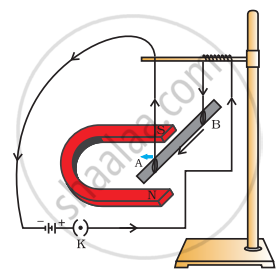
- Why does the rod get displaced on passing current through it?
- State the rule that determines the direction of the force on the conductor AB.
-
- If the U-shaped magnet is held vertically and the aluminium rod is suspended horizontally with its end B towards due north, then on passing current through the rod from B to A as shown, in which direction will the rod be displaced?
- Name any two devices that use current carrying conductors and magnetic fields.
OR
Draw the pattern of magnetic field lines produced around a current carrying straight conductor held vertically on a horizontal cardboard. Indicate the direction of the field lines as well as the direction of current flowing through the conductor.
As shown in the diagram an aluminium rod 'AB' is suspended horizontally between the two poles of a strong horse shoe magnet in such a way that the axis of rod is horizontal and the direction of the magnetic field is vertically upward. The rod is connected in series with a battery and a key.
State giving reason:
- What is observed when a current is passed through the aluminium rod from end B to end A?
- What change is observed in a situation in which the axis of the rod 'AB' is moved and aligned parallel to the magnetic field and current is passed in the rod in the same direction?
A rectangular loop ABCD carrying a current I is situated near a straight conductor XY, such that the conductor is parallel to the side AB of the loop and is in the plane of the loop. If a steady current I is established in the conductor as shown, the conductor XY will ______.

