Advertisements
Advertisements
प्रश्न
How does the resistance of a wire vary with its area of cross-section?
Advertisements
उत्तर
Resistance (R) of a wire is inversely proportional to its area of cross-section (A),
`"R" ∝ 1/"A"`
i.e., when the area of cross section increases, resistance decreases, or vice versa.
संबंधित प्रश्न
Compute the heat generated while transferring 96000 coulomb of charge in one hour through a potential difference of 50 V.
An electric heater is connected to the 230 V mains supply. A current of 8 A flows through the heater.
- How much charge flows around the circuit each second?
- How much energy is transferred to the heater each second?
Why is a series arrangement not used for connecting domestic electrical appliances in a circuit?
The current passing through a room heater has been halved. What will happen to the heat produced by it?
The electrical resistivities of four materials P, Q, R and S are given below:
| P | `6.84xx10^8`Ωm |
| Q | `1.70xx10^8`Ωm |
| R | ` 1.0xx10^15`Ωm |
| s | `11.0xx10^-7`Ωm |
Which material will you use for making: (a) heating element of electric iron (b) connecting wires of electric iron (c) covering of connecting wires? Give reason for your choice in each case.
Which electric heating device in your home do you think have resistors which control the flow of electricity?
Name the factors on which the heat produced in a wire depends when current is passed in it, and state how does it depend on the factors stated by you.
The ‘live’ and the ‘neutral’ wires have potential difference of _______.
The electricity bill specifies the usage in _______.
A coil of an alloy _______ is used in electric heater cooker as a resistor.
Find the odd one out and give its explanation.
When does overloading occur?
What does overloading cause?
Name some devices that run using heat effect of electric current
Which of the following gases are filled in electric bulbs?
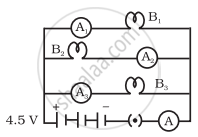
B1, B2 and B3 are three identical bulbs connected as shown in Figure. When all the three bulbs glow, a current of 3A is recorded by the ammeter A.
- What happens to the glow of the other two bulbs when the bulb B1 gets fused?
- What happens to the reading of A1, A2, A3 and A when the bulb B2 gets fused?
- How much power is dissipated in the circuit when all the three bulbs glow together?
Can we use the same fuse in a geyser and a television set? Explain.
Your teacher has shown you the following activity.
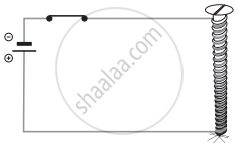
Activity: Teacher has wound a long insulated piece of wire around an iron nail in the form of a coil. Free ends of the wire are connected to a cell through a switch as shown in the following figure. The current is switched on and some pins are placed near the ends of the nail.
Write down any three questions that come to your mind about this activity.
______ wire is used in the filament of the bulbs.
Anannya responded to the question: Why do electrical appliances with metallic bodies are connected to the mains through a three-pin plug, whereas an electric bulb can be connected with a two-pin plug?
She wrote: Three-pin connections reduce heating of connecting wires.
- Is her answer correct or incorrect? Justify.
- What is the function of a fuse in a domestic circuit?
