Advertisements
Advertisements
प्रश्न
An electric fuse works on the:
(a) chemical effect of current
(b) magnetic effect of current
(c) lighting effect of current
(d) heating effect of current
Advertisements
उत्तर
(d) heating effect of current
An electric fuse works on the heating effect of current.
APPEARS IN
संबंधित प्रश्न
Why is the tungsten used almost exclusively for filament of electric lamps?
An electric heater is connected to the 230 V mains supply. A current of 8 A flows through the heater.
- How much charge flows around the circuit each second?
- How much energy is transferred to the heater each second?
The electrical resistivities of four materials P, Q, R and S are given below:
| P | `6.84xx10^8`Ωm |
| Q | `1.70xx10^8`Ωm |
| R | ` 1.0xx10^15`Ωm |
| s | `11.0xx10^-7`Ωm |
Which material will you use for making: (a) heating element of electric iron (b) connecting wires of electric iron (c) covering of connecting wires? Give reason for your choice in each case.
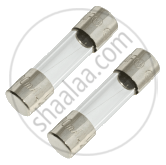
Identify the figure and give its use.
Compute the heat generated while transferring 96000 coulombs of charge in two hours through a potential difference of 40 V.
Right or wrong sentence.
Live wire and neutral wires have a 220 V potential difference.
When does overloading occur?
True or False – If False give the correct answer
The fuse wire does not melts whenever there is overload in the wiring.
Explain the heating effect of electric current.
Fuse is a strip of alloy wire which is made up of lead and tin with a very low ______.
Match the following
| 1. | Bulb | a. | Conductor |
| 2. | Electroplating | b. |
Insulator |
| 3. | Pure water | c. | Heating effect of current |
| 4. | Salt solution | d. | Chemical effect of current |
Name the effect of the current responsible for the glow of the bulb in an electrical circuit.
The following is not a safety device.
An electrochemical cell converts ______ energy into ______ energy.
The electric fuse works on the Joule heating principle.
Explain why fuse wire is always connected in a series arrangement.
Define the following:
Electrolyte
When a current I flows through a wire of resistance R for time t then the electrical energy produced is given by ______.
