Advertisements
Advertisements
Question
An electric fuse works on the:
(a) chemical effect of current
(b) magnetic effect of current
(c) lighting effect of current
(d) heating effect of current
Advertisements
Solution
(d) heating effect of current
An electric fuse works on the heating effect of current.
APPEARS IN
RELATED QUESTIONS
State four most common electrical appliances based on heating effect of electric current. Why do we use finely heated platinum wire in surgery?
Why does the cord of an electric heater not glow while the heating element does?
Compute the heat generated while transferring 96000 coulomb of charge in one hour through a potential difference of 50 V.
Why are the conductors of electric heating devices, such as bread-toasters and electric irons, made of an alloy rather than a pure metal?
The safety device based on the heating effect of electric current is called a ______.
Write Joule's law of heating.
A resistance of 25 Ω is connected to a 12 V battery. Calculate the heat energy in joules generated per minute.
How much heat will an instrument of 12 W produce in one minute if it is connected to the heat produced by it?
Identify the figure and give its use.
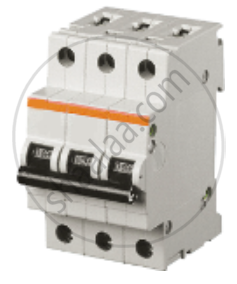
Answer the following question:
what is the heating effect of the electric current? state any four applications of it?
What is the heating effect of electric current?
What is used to turn off the sudden increase in current in the electrical circuit of the house nowadays?
Right or wrong sentence.
Live wire and neutral wires have a 220 V potential difference.
A current of 1 A is drawn by a filament of an electric bulb. Number of electrons passing through a cross-section of the filament in 16 seconds would be roughly:
An electric fuse has a body made of ceramic and two points for connecting the fuse wire.
What are the uses of electromagnets?
Copper wire offers very little ______ and does not get heated up quickly.
The following is not a safety device.
State the law that explains the heating effect of current with respect to the measurable properties in an electrical circuit.
