Advertisements
Advertisements
Question
What is the heating effect of electric current?
Advertisements
Solution
When electricity is applied to a conductor that is solely resistive, all of the energy from the electric current is converted to heat. Resistor heats up as a result. Electric current's heating impact is defined as the heating of a resistor as a result of electrical energy loss.
APPEARS IN
RELATED QUESTIONS
An electric iron of resistance 20 Ω takes a current of 5 A. Calculate the heat developed in 30 s.
Give two reasons why nichrome alloy is used for making the heating elements of electrical appliances.
Explain why, the current that makes the heater element very hot, only slightly warms the connecting wires leading to the heater.
Three heaters each rated 250 W, 100 V are connected in parallel to a 100 V supply. Calculate:
- the total current taken from the supply
- the resistance of each heater and
- the energy supplied in kWh to the three heaters in 5 hours.
Assertion: Bending of wire decreases the resistance of the electric wire.
Reason: The resistance of a conductor depends on length, thickness, nature of material and temperature of the conductor.
Why is parallel arrangement used in domestic wiring?
Name two electric devices for each where
- heating effect of current is used and
- magnetic effect of current is used.
Your teacher has shown you the following activity.
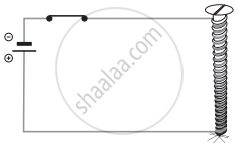
Activity: Teacher has wound a long insulated piece of wire around an iron nail in the form of a coil. Free ends of the wire are connected to a cell through a switch as shown in the following figure. The current is switched on and some pins are placed near the ends of the nail.
Write down any three questions that come to your mind about this activity.
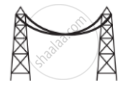
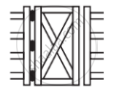
In which of the following applications of Iron, rusting will occur most? Support your answer with valid reason.
| A | B | C | D |
 |
 |
 |
 |
An electric kettle consumes 1 kW of electric power when operated at 220 V. A fuse wire of what rating must be used for it?
