Advertisements
Advertisements
Question
Statement 1 : Electric current ( flow of electrons ) creates heat in the resistor.
Statement 2 : Heat in the resistor is created according to the rule of energy conservation.
Explain Statement 1 with the help of Statement 2.
Advertisements
Solution
i. When electrons flows through the resistor (during flowing electric current) electron possesses kinetic energy.
ii. During the flow of electron there is decrease in kinetic energy of electrons due to collision on atoms, ions and molecules.
iii. According to the law of conservation of energy decrease in kinetic energy gets converted into heat.
APPEARS IN
RELATED QUESTIONS
Compute the heat generated while transferring 96000 coulomb of charge in one hour through a potential difference of 50 V.
Why is the tungsten used almost exclusively for filament of electric lamps?
Name any two effects of electric current.
The safety device based on the heating effect of electric current is called a ______.
An electric heater is connected to the 230 V mains supply. A current of 8 A flows through the heater.
(b) How much energy is transferred to the heater each second?
What is nichrome? State its one use.
Give two reasons why nichrome alloy is used for making the heating elements of electrical appliances.
An electric iron of resistance 20 ohms draws a current of 5 amperes. Calculate the heat produced in 30 seconds.
Explain why, tungsten is used for making the filaments of electric bulbs.
What is meant by the heating effect of current?
The elements of electrical heating devices are usually made of:
(a) tungsten
(b) bronze
(c) nichrome
(d) argon
If the current flowing through a fixed resistor is halved, the heat produced in it will become:
Two exactly similar heating resistances are connected (i) in series, and (ii) in parallel, in two different circuits, one by one. If the same current is passed through both the combinations, is more heat obtained per minute when they are connected in series or when they are connected in parallel? Give reason for your answer.
Which electric heating device in your home do you think have resistors which control the flow of electricity?
Give a scientific reason.
Tungsten metal is used to make a solenoid type coil in an electric bulb.
Heat energy is being produced in a resistance in a circuit at the rate of 100 W. The current of 3 A is flowing in the circuit. What must be the value of the resistance?
The ‘live’ and the ‘neutral’ wires have potential difference of _______.
Find the odd one out and give its explanation.
What is the heating effect of electric current?
Explain the importance/uses of fuse wire.
The heating element of an electric iron is made up of:
An electric bulb is connected to a 220 V generator. The current is 0.50 A. What is the power of the bulb?
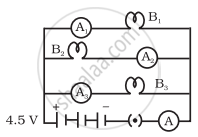
B1, B2 and B3 are three identical bulbs connected as shown in Figure. When all the three bulbs glow, a current of 3A is recorded by the ammeter A.
- What happens to the glow of the other two bulbs when the bulb B1 gets fused?
- What happens to the reading of A1, A2, A3 and A when the bulb B2 gets fused?
- How much power is dissipated in the circuit when all the three bulbs glow together?
(a) Observe the diagram given below and state whether the bulb will glow or not when we switch on K.
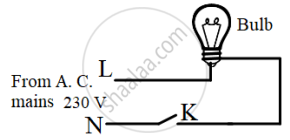
(b) Is it safe to handle the bulb when the switch is OFF?
(c) Give a reason for your answer in (b).
An electric component used as a safety device is electric circuit is ______.
Name two electric devices for each where
- heating effect of current is used and
- magnetic effect of current is used.
Your teacher has shown you the following activity.
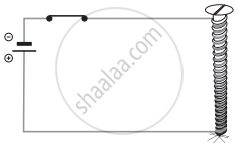
Activity: Teacher has wound a long insulated piece of wire around an iron nail in the form of a coil. Free ends of the wire are connected to a cell through a switch as shown in the following figure. The current is switched on and some pins are placed near the ends of the nail.
Write down any three questions that come to your mind about this activity.
What are the factors affecting heating effect of electric current?
______ wire is used in the filament of the bulbs.
Copper wire offers very little ______ and does not get heated up quickly.
Fuse is a strip of alloy wire which is made up of lead and tin with a very low ______.
An electric fuse is a wire made up of a material having ______ melting point.
An electrochemical cell converts ______ energy into ______ energy.
Find the odd one out.
Two students decided to investigate the effect of water and air on iron object under identical experimental conditions. They measured the mass of each object before placing it partially immersed in 10 ml of water. After a few days, the object were removed, dried and their masses were measured. The table shows their results.
| Student | Object | Mass of Object before Rusting in g |
Mass of the coated object in g |
| A | Nail | 3.0 | 3.15 |
| B | Thin plate | 6.0 | 6.33 |
What might be the reason for the varied observations of the two students?
Anannya responded to the question: Why do electrical appliances with metallic bodies are connected to the mains through a three-pin plug, whereas an electric bulb can be connected with a two-pin plug?
She wrote: Three-pin connections reduce heating of connecting wires.
- Is her answer correct or incorrect? Justify.
- What is the function of a fuse in a domestic circuit?
When a current I flows through a wire of resistance R for time t then the electrical energy produced is given by ______.
