Advertisements
Advertisements
Question
What does overloading cause?
Advertisements
Solution
Due to overloading, fuse wire melts and the supply gets shut down.
APPEARS IN
RELATED QUESTIONS
Why does the cord of an electric heater not glow while the heating element does?
Compute the heat generated while transferring 96000 coulomb of charge in one hour through a potential difference of 50 V.
How does the resistance of a wire vary with its area of cross-section?
Name any two effects of electric current.
The safety device based on the heating effect of electric current is called a ______.
An electric heater is connected to the 230 V mains supply. A current of 8 A flows through the heater.
(b) How much energy is transferred to the heater each second?
A resistance of 25 Ω is connected to a 12 V battery. Calculate the heat energy in joules generated per minute.
The heat produced by passing an electric current through a fixed resistor is proportional to the square of:
(a) magnitude of resistance of the resistor
(b) temperature of the resistor
(c) magnitude of current
(d) time for which current is passed
An electric fuse works on the:
(a) chemical effect of current
(b) magnetic effect of current
(c) lighting effect of current
(d) heating effect of current
If the current flowing through a fixed resistor is halved, the heat produced in it will become:
An electric iron is connected to the mains power supply of 220 V. When the electric iron is adjusted at ‘minimum heating' it consumes a power of 360 W but at 'maximum heating’ it takes a power of 840 W. Calculate the current and resistance in each case.
Identify the figure and give its use.
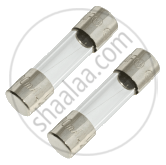
An electric iron of 1100 W is operated for 2 hrs daily. What will be the electrical consumption expenses for that in the month of April? (The electric company charges Rs 5 per unit of energy).
In an electric bulb, coil of _______ metal is used.
These days when current in the circuit suddenly increases _______ switches are used.
A coil of an alloy _______ is used in electric heater cooker as a resistor.
Explain the importance/uses of fuse wire.
Explain the application of heating effect of electric current in an electric bulb with a diagram.
True or False – If False give the correct answer
The fuse wire does not melts whenever there is overload in the wiring.
Define fuse.
Heating effect of current is called ______
An electric iron consumes energy at the rate of 420 W when heating is at the maximum rate and 180 W when heating is at the minimum rate. The applied voltage is 220 V. What is the current in each case?
A current of 1 A is drawn by a filament of an electric bulb. Number of electrons passing through a cross-section of the filament in 16 seconds would be roughly:
Which of the following gases are filled in electric bulbs?
An electric kettle consumes 1 kW of electric power when operated at 220 V. A fuse wire of what rating must be used for it?
How does use of a fuse wire protect electrical appliances?
Fuse is a strip of alloy wire which is made up of lead and tin with a very low ______.
Assertion: A current-carrying wire should be charged.
Reason: The current in a wire is due to the flow of free electrons in a definite direction.
Name the effect of the current responsible for the glow of the bulb in an electrical circuit.
A student boils water in an electric kettle for 20 minutes. Using the same mains supply he wants to reduce the boiling time of water. To do so should he increase or decrease the length of the heating element? Justify your answer.
Tara, after completing her exams, went to her grandmother's house along with her younger brother Rahul. One day, Rahul came home after playing and switched on the fan and air conditioner. At the same time, his grandmother was preparing a milkshake for him using a mixer. Suddenly, they heard a big sound and the electricity of the house got shut down. Tara is called an electrician. He said the main reason for supply to shut down was overloading.
- What is overloading?
- Is overloading and short the same? When does short-circuiting take place?
- How can the effects of overloading be avoided?
In which of the following applications of Iron, rusting will occur most? Support your answer with valid reason.
| A | B | C | D |
 |
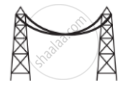 |
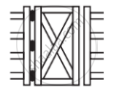 |
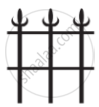 |
An electric kettle of 2 kW is used for 2h. Calculate the energy consumed in
- kilowatt hour and
- joules.
Write an expression for the amount of heat produced in a resistor when an electric current is passed through it stating the meanings of the symbols used.
An electric iron is rated 220 V, 2 kW. If the iron is used for 3h daily find the cost of running it for one week if it costs ₹ 4.25 per kWh.
