Advertisements
Advertisements
Question
What is the heating effect of electric current?
Advertisements
Solution
When a resistor is connected in an electrical circuit, heat is produced in it due to the current. This is known as the heating effect of current.
APPEARS IN
RELATED QUESTIONS
State four most common electrical appliances based on heating effect of electric current. Why do we use finely heated platinum wire in surgery?
Why does the cord of an electric heater not glow while the heating element does?
Why is the tungsten used almost exclusively for filament of electric lamps?
An electric heater is connected to the 230 V mains supply. A current of 8 A flows through the heater.
(b) How much energy is transferred to the heater each second?
An electric room heater draws a current of 2.4 A from the 120 V supply line. What current will this room heater draw when connected to 240 V supply line?
The current passing through a room heater has been halved. What will happen to the heat produced by it?
The elements of electrical heating devices are usually made of:
(a) tungsten
(b) bronze
(c) nichrome
(d) argon
How does the wire in the filament of a light bulb behave differently to the other wires in the circuit when the current flows?
What property of the filament wire accounts for this difference?
Three heaters each rated 250 W, 100 V are connected in parallel to a 100 V supply. Calculate:
- the total current taken from the supply
- the resistance of each heater and
- the energy supplied in kWh to the three heaters in 5 hours.
Give Scientific reason.
In practice, the unit kWh is used for the measurement of electrical energy, rather than joule.
Heat energy is being produced in a resistance in a circuit at the rate of 100 W. The current of 3 A is flowing in the circuit. What must be the value of the resistance?
The electricity bill specifies the usage in _______.
Which of the following substance contracts on heating?
What is used to turn off the sudden increase in current in the electrical circuit of the house nowadays?
When does overloading occur?
How can overloading be avoided?
An electric iron consumes energy at the rate of 420 W when heating is at the maximum rate and 180 W when heating is at the minimum rate. The applied voltage is 220 V. What is the current in each case?
Which of the following gases are filled in electric bulbs?
Why is parallel arrangement used in domestic wiring?
Three incandescent bulbs of 100 W each are connected in series in an electric circuit. In another circuit another set of three bulbs of the same wattage are connected in parallel to the same source.
- Will the bulb in the two circuits glow with the same brightness? Justify your answer.
- Now let one bulb in both the circuits get fused. Will the rest of the bulbs continue to glow in each circuit? Give reason.
What is Joule’s heating effect? How can it be demonstrated experimentally? List its four applications in daily life.
(a) Observe the diagram given below and state whether the bulb will glow or not when we switch on K.
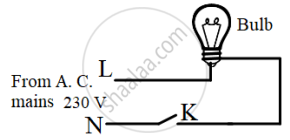
(b) Is it safe to handle the bulb when the switch is OFF?
(c) Give a reason for your answer in (b).
An electric cell produces electricity from the ______ ______ in it.
Can we use the same fuse in a geyser and a television set? Explain.
What is an electric fuse made up of?
What are the factors affecting heating effect of electric current?
Assertion: A current-carrying wire should be charged.
Reason: The current in a wire is due to the flow of free electrons in a definite direction.
Name the effect of the current responsible for the glow of the bulb in an electrical circuit.
An electrochemical cell converts ______ energy into ______ energy.
The electric fuse works on the Joule heating principle.
In the electric equipment producing heat like iron, electric heater, boiler, toaster etc., an alloy such as nichrome is used, not pure metals.
An electric kettle consumes 1 kW of electric power when operated at 220 V. A fuse wire of what rating must be used for it?
An electric kettle of 2 kW is used for 2h. Calculate the energy consumed in
- kilowatt hour and
- joules.
What is the heating effect of electric current?
