Advertisements
Advertisements
Question
Explain the application of heating effect of electric current in an electric bulb with a diagram.
Advertisements
Solution
- Electric bulb works on the principle of heating effect electric of current.
- The solenoid type coil of bulb has high resistivity and very high melting point.
- When current is passed through the bulb, solenoid type coil of bulb gets heated to high temperature (upto 3400 °C) and starts glowing.

RELATED QUESTIONS
Why does the cord of an electric heater not glow while the heating element does?
An electric heater of resistance 8 Ω draws 15 A from the service mains 2 hours. Calculate the rate at which heat is developed in the heater.
Why are the conductors of electric heating devices, such as bread-toasters and electric irons, made of an alloy rather than a pure metal?
The safety device based on the heating effect of electric current is called a ______.
An electric room heater draws a current of 2.4 A from the 120 V supply line. What current will this room heater draw when connected to 240 V supply line?
What is nichrome? State its one use.
Write down the formula for the heat produced when a current I is passed through a resistor R for time t.
Explain why, the current that makes the heater element very hot, only slightly warms the connecting wires leading to the heater.
A heating coil has a resistance of 200 Ω. At what rate will heat be produced in it when a current of 2.5 A flows through it?
Name the material which is used for making the filaments of an electric bulb.
The heat produced by passing an electric current through a fixed resistor is proportional to the square of:
(a) magnitude of resistance of the resistor
(b) temperature of the resistor
(c) magnitude of current
(d) time for which current is passed
Which of the following characteristic is not suitable for a fuse wire?
(a) thin and short
(b) thick and short
(c) low melting point
(d) higher resistance than rest of wiring
An electric iron is connected to the mains power supply of 220 V. When the electric iron is adjusted at ‘minimum heating' it consumes a power of 360 W but at 'maximum heating’ it takes a power of 840 W. Calculate the current and resistance in each case.
Identify the figure and give its use.
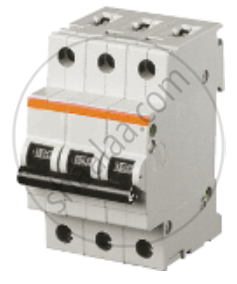
Solve the following example.
Two tungsten bulbs of wattage 100 W and 60 W power work on 220 V potential difference. If they are connected in parallel, how much current will flow in the main conductor?
Give scientific reason :
In the electric equipment producing heat e.g. iron, electric heater, boiler, toaster, etc., an alloy such as Nichrome is used, not pure metals.
Compute the heat generated while transferring 96000 coulombs of charge in two hours through a potential difference of 40 V.
Which metal is used to make the filament of an electric bulb?
What is a short circuit?
What is used to turn off the sudden increase in current in the electrical circuit of the house nowadays?
Write two devices based on the heating effect of electric current.
When does overloading occur?
Mark the correct choice
- Assertion: Electric appliances with a metallic body have three wire connections.
- Reason: Three-pin connections reduce the heating of the connecting wires.
The heating element of an electric iron is made up of:
When a switch is in OFF position,
- circuit starting from the positive terminal of the cell stops at the switch.
- circuit is open.
- no current flows through it.
- current flows after some time.
Choose the combination of correct answer from the following.
Can we use the same fuse in a geyser and a television set? Explain.
Explain the working of an electric fuse.
Match the following
| 1. | Bulb | a. | Conductor |
| 2. | Electroplating | b. |
Insulator |
| 3. | Pure water | c. | Heating effect of current |
| 4. | Salt solution | d. | Chemical effect of current |
Name the effect of the current responsible for the glow of the bulb in an electrical circuit.
A trip switch is a ______ safety device.
Explain why fuse wire is always connected in a series arrangement.
An electric kettle consumes 1 kW of electric power when operated at 220 V. A fuse wire of what rating must be used for it?
Write an expression for the amount of heat produced in a resistor when an electric current is passed through it stating the meanings of the symbols used.
The graph of voltage vs current for four different materials is shown below.

Which of these four materials would be used for making filament of bulb?
An electric iron is rated 220 V, 2 kW. If the iron is used for 3h daily find the cost of running it for one week if it costs ₹ 4.25 per kWh.
