Advertisements
Advertisements
Question
An electric iron of 1100 W is operated for 2 hrs daily. What will be the electrical consumption expenses for that in the month of April? (The electric company charges Rs 5 per unit of energy).
Advertisements
Solution
Electric power required for working of iron, P = 1100 W
Duration for which the iron is operated daily = 2 h = \[2 \times 60 \times 60 = 7200 s \]
Electric energy consumed by iron in 7200 s is
or, \[1 J = \frac{1}{3 . 6 \times {10}^6} \] unit
Thus,
\[237600000 J = \frac{237600000}{3 . 6 \times 1000000} = 66\] units
RELATED QUESTIONS
State four most common electrical appliances based on heating effect of electric current. Why do we use finely heated platinum wire in surgery?
How does the resistance of a wire vary with its area of cross-section?
An electric room heater draws a current of 2.4 A from the 120 V supply line. What current will this room heater draw when connected to 240 V supply line?
A resistance of 25 Ω is connected to a 12 V battery. Calculate the heat energy in joules generated per minute.
Derive the expression for the heat produced due to a current 'I' flowing for a time interval 't' through a resistor 'R' having a potential difference 'V' across its ends. With which name is this relation known?
The heat produced by passing an electric current through a fixed resistor is proportional to the square of:
(a) magnitude of resistance of the resistor
(b) temperature of the resistor
(c) magnitude of current
(d) time for which current is passed
An electric iron is connected to the mains power supply of 220 V. When the electric iron is adjusted at ‘minimum heating' it consumes a power of 360 W but at 'maximum heating’ it takes a power of 840 W. Calculate the current and resistance in each case.
Which electric heating device in your home do you think have resistors which control the flow of electricity?
Give Scientific reason.
In practice, the unit kWh is used for the measurement of electrical energy, rather than joule.
Heat energy is being produced in a resistance in a circuit at the rate of 100 W. The current of 3 A is flowing in the circuit. What must be the value of the resistance?
Statement 1 : Electric current ( flow of electrons ) creates heat in the resistor.
Statement 2 : Heat in the resistor is created according to the rule of energy conservation.
Explain Statement 1 with the help of Statement 2.
Statement 1 : Electric current ( flow of electrons ) creates heat in the resistor.
Statement 2 : Heat in the resistor is created according to the rule of energy conservation.
Explain Statement 1 with the help of Statement 2.
Answer the following question:
what is the heating effect of the electric current? state any four applications of it?
Find the odd one out and give its explanation.
What is the heating effect of electric current?
What is a short circuit?
What is overloading?
Write two devices based on the heating effect of electric current.
When does overloading occur?
Define fuse.
Name some devices that run using heat effect of electric current
An electric iron draws a current of 4 A when connected to 220 V mains. Its resistance must be:
A fuse wire repeatedly gets burnt when used with a good heater. It is advised to use a fuse wire of:
Assertion: Bending of wire decreases the resistance of the electric wire.
Reason: The resistance of a conductor depends on length, thickness, nature of material and temperature of the conductor.
How does use of a fuse wire protect electrical appliances?
Why is parallel arrangement used in domestic wiring?
Unscramble the following words:
SFEU
Can we use the same fuse in a geyser and a television set? Explain.
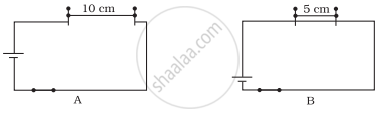
Paheli took a wire of length 10 cm. Boojho took a wire of 5 cm of the same material and thickness. Both of them connected the wires as shown in the circuit given in the following figure. The current flowing in both the circuits is the same.
- Will the heat produced in both cases be equal? Explain.
- Will the heat produced be the same if the wires taken by them are of equal lengths but of different thickness? Explain.
An MCB can be used instead of a fuse in an electrical circuit.
What are the uses of electromagnets?
What is an electric fuse made up of?
Match the following
| 1. | Bulb | a. | Conductor |
| 2. | Electroplating | b. |
Insulator |
| 3. | Pure water | c. | Heating effect of current |
| 4. | Salt solution | d. | Chemical effect of current |
Name the effect of the current responsible for the glow of the bulb in an electrical circuit.
The following is not a safety device.
Two students decided to investigate the effect of water and air on iron object under identical experimental conditions. They measured the mass of each object before placing it partially immersed in 10 ml of water. After a few days, the object were removed, dried and their masses were measured. The table shows their results.
| Student | Object | Mass of Object before Rusting in g |
Mass of the coated object in g |
| A | Nail | 3.0 | 3.15 |
| B | Thin plate | 6.0 | 6.33 |
What might be the reason for the varied observations of the two students?
In a set up the students coated iron nails with zinc metal and noted that, iron nails coated with zinc prevents rusting. They also observed that zinc initially acts as a physical barrier, but an extra advantage of using zinc is that it continues to prevent rusting even if the layer of zinc is damaged. Name this process of rust prevention and give any two other methods to prevent rusting.
The graph of voltage vs current for four different materials is shown below.

Which of these four materials would be used for making filament of bulb?
