Advertisements
Advertisements
Question
Which electric heating device in your home do you think have resistors which control the flow of electricity?
Advertisements
Solution
The following electric heating devices have resistors to control the flow of electricity:
Electric iron
Electric geyser
Electric oven
Electric heater
APPEARS IN
RELATED QUESTIONS
Why is a series arrangement not used for connecting domestic electrical appliances in a circuit?
If the current flowing through a fixed resistor is halved, the heat produced in it will become:
The electrical resistivities of four materials P, Q, R and S are given below:
| P | `6.84xx10^8`Ωm |
| Q | `1.70xx10^8`Ωm |
| R | ` 1.0xx10^15`Ωm |
| s | `11.0xx10^-7`Ωm |
Which material will you use for making: (a) heating element of electric iron (b) connecting wires of electric iron (c) covering of connecting wires? Give reason for your choice in each case.
Identify the figure and give its use.
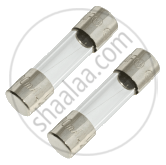
What does overloading cause?
Which of the following is correct?
An electric iron consumes energy at the rate of 420 W when heating is at the maximum rate and 180 W when heating is at the minimum rate. The applied voltage is 220 V. What is the current in each case?
An electric kettle consumes 1 kW of electric power when operated at 220 V. A fuse wire of what rating must be used for it?
An MCB can be used instead of a fuse in an electrical circuit.
What is an electric fuse made up of?
Assertion: A current-carrying wire should be charged.
Reason: The current in a wire is due to the flow of free electrons in a definite direction.
What is a trip switch?
A fuse is used in an electric circuit to stop high currents flowing through the circuit.
The electric fuse works on the Joule heating principle.
Explain why fuse wire is always connected in a series arrangement.
If 220 V potential difference is applied across an electric bulb, a current of 0.45 A flows in the bulb. What must be the power of the bulb?
State the law that explains the heating effect of current with respect to the measurable properties in an electrical circuit.
An electric iron of resistance 20 Ω draws a current of 5 A. The heat developed in the iron in 30 seconds is ______.
The graph of voltage vs current for four different materials is shown below.

Which of these four materials would be used for making filament of bulb?
An electric iron is rated 220 V, 2 kW. If the iron is used for 3h daily find the cost of running it for one week if it costs ₹ 4.25 per kWh.
