Advertisements
Advertisements
Question
If 220 V potential difference is applied across an electric bulb, a current of 0.45 A flows in the bulb. What must be the power of the bulb?
Options
99 W
70 W
45 W
22 W
Advertisements
Solution
99 W
Explanation:
Given:
Potential difference = 220 V, Current = 0.45 A
Power (W) = Potential difference (V) × Current (A)
= 220 × 0.45 W
= 99 W
So, the bulb must be of power 99 W.
APPEARS IN
RELATED QUESTIONS
Why does the cord of an electric heater not glow while the heating element does?
Compute the heat generated while transferring 96000 coulomb of charge in one hour through a potential difference of 50 V.
An electric heater of resistance 8 Ω draws 15 A from the service mains 2 hours. Calculate the rate at which heat is developed in the heater.
When current is switched ‘on’ in a room heater, it ______.
Write Joule's law of heating.
An electric heater is connected to the 230 V mains supply. A current of 8 A flows through the heater.
- How much charge flows around the circuit each second?
- How much energy is transferred to the heater each second?
An electric room heater draws a current of 2.4 A from the 120 V supply line. What current will this room heater draw when connected to 240 V supply line?
What is nichrome? State its one use.
Explain why, the current that makes the heater element very hot, only slightly warms the connecting wires leading to the heater.
The current passing through an electric kettle has been doubled. The heat produced will become:
(a) half
(b) double
(c) four time
(d) one-fourth
Which of the following characteristic is not suitable for a fuse wire?
(a) thin and short
(b) thick and short
(c) low melting point
(d) higher resistance than rest of wiring
Give a scientific reason.
Tungsten metal is used to make a solenoid type coil in an electric bulb.
Solve the following example.
Two tungsten bulbs of wattage 100 W and 60 W power work on 220 V potential difference. If they are connected in parallel, how much current will flow in the main conductor?
The ‘live’ and the ‘neutral’ wires have potential difference of _______.
A coil of an alloy _______ is used in electric heater cooker as a resistor.
Find the odd one out and give its explanation.
Which metal is used to make the filament of an electric bulb?
What is a short circuit?
What is overloading?
Name any two appliances which works on the phenomenon of heating effect of electric current.
What does overloading cause?
Explain the application of heating effect of electric current in an electric bulb with a diagram.
True or False – If False give the correct answer
The fuse wire does not melts whenever there is overload in the wiring.
Mark the correct choice
- Assertion: Electric appliances with a metallic body have three wire connections.
- Reason: Three-pin connections reduce the heating of the connecting wires.
How does use of a fuse wire protect electrical appliances?
Why is parallel arrangement used in domestic wiring?
Three incandescent bulbs of 100 W each are connected in series in an electric circuit. In another circuit another set of three bulbs of the same wattage are connected in parallel to the same source.
- Will the bulb in the two circuits glow with the same brightness? Justify your answer.
- Now let one bulb in both the circuits get fused. Will the rest of the bulbs continue to glow in each circuit? Give reason.
What is Joule’s heating effect? How can it be demonstrated experimentally? List its four applications in daily life.
Copper wire offers very little ______ and does not get heated up quickly.
Fuse is a strip of alloy wire which is made up of lead and tin with a very low ______.
Match the following
| 1. | Bulb | a. | Conductor |
| 2. | Electroplating | b. |
Insulator |
| 3. | Pure water | c. | Heating effect of current |
| 4. | Salt solution | d. | Chemical effect of current |
An electric fuse is a wire made up of a material having ______ melting point.
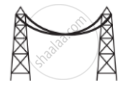
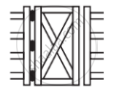
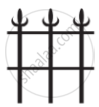
In which of the following applications of Iron, rusting will occur most? Support your answer with valid reason.
| A | B | C | D |
 |
 |
 |
 |
An electric kettle consumes 1 kW of electric power when operated at 220 V. A fuse wire of what rating must be used for it?
An electric kettle of 2 kW is used for 2h. Calculate the energy consumed in
- kilowatt hour and
- joules.
State the law that explains the heating effect of current with respect to the measurable properties in an electrical circuit.
When a current I flows through a wire of resistance R for time t then the electrical energy produced is given by ______.
