Advertisements
Advertisements
Question
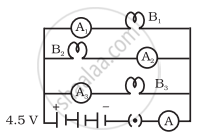
B1, B2 and B3 are three identical bulbs connected as shown in Figure. When all the three bulbs glow, a current of 3A is recorded by the ammeter A.
- What happens to the glow of the other two bulbs when the bulb B1 gets fused?
- What happens to the reading of A1, A2, A3 and A when the bulb B2 gets fused?
- How much power is dissipated in the circuit when all the three bulbs glow together?
Advertisements
Solution
Since all the three bulbs are identical so current through each bulb will remain same i.e 1 A
- Even when bulb B1 gets fused, other two bulbs will continue to glow with same brightness because all the three bulbs are connected in parallel so potential difference across each bulb remains same.
- When bulb B2 gets fused then the reading A2 will become zero. The reading of A1 and A3 will remain same as 1 A because potential difference across them remains same. However, the reading of A will decrease and will become 2 A.
- Power dissipated by bulb B1 will be
P1 = VI
P1 = 4.5 × 1
P1 = 4.5 W
Similarly,
P2 = 4.5 W
P3 = 4.5 W
Hence total power dissipated by the circuit will be
Pnet = P1 + P2 + P3
Pnet = 4.5 + 4.5 + 4.5
Pnet = 13.5W
APPEARS IN
RELATED QUESTIONS
An electric heater of resistance 8 Ω draws 15 A from the service mains 2 hours. Calculate the rate at which heat is developed in the heater.
Write Joule's law of heating.
An electric heater is connected to the 230 V mains supply. A current of 8 A flows through the heater.
(b) How much energy is transferred to the heater each second?
How does the resistance of a wire vary with its:
diameter?
Why is a series arrangement not used for connecting domestic electrical appliances in a circuit?
An electric iron of resistance 20 ohms draws a current of 5 amperes. Calculate the heat produced in 30 seconds.
Derive the expression for the heat produced due to a current 'I' flowing for a time interval 't' through a resistor 'R' having a potential difference 'V' across its ends. With which name is this relation known?
The heat produced by passing an electric current through a fixed resistor is proportional to the square of:
(a) magnitude of resistance of the resistor
(b) temperature of the resistor
(c) magnitude of current
(d) time for which current is passed
Give a scientific reason.
Tungsten metal is used to make a solenoid type coil in an electric bulb.
Give Scientific reasons.
In the electric equipment producing heat e.g. iron, electric heater, boiler, toaster etc, an alloy such as Nichrome is used, not pure metals.
An electric iron of 1100 W is operated for 2 hrs daily. What will be the electrical consumption expenses for that in the month of April? (The electric company charges Rs 5 per unit of energy).
Write scientific reason.
A coil made up of alloy Nichrome is used in the electric heater cooker as a resistor.
What does overloading cause?
How can overloading be avoided?
Which of the following is correct?
A fuse wire repeatedly gets burnt when used with a good heater. It is advised to use a fuse wire of:
Can we use the same fuse in a geyser and a television set? Explain.
A fuse is used in an electric circuit to stop high currents flowing through the circuit.
An electric kettle consumes 1 kW of electric power when operated at 220 V. A fuse wire of what rating must be used for it?
State the law that explains the heating effect of current with respect to the measurable properties in an electrical circuit.
