Advertisements
Advertisements
Question
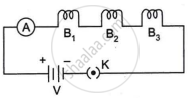
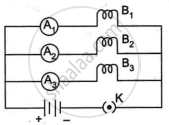
Three incandescent bulbs of 100 W each are connected in series in an electric circuit. In another circuit another set of three bulbs of the same wattage are connected in parallel to the same source.
- Will the bulb in the two circuits glow with the same brightness? Justify your answer.
- Now let one bulb in both the circuits get fused. Will the rest of the bulbs continue to glow in each circuit? Give reason.
Advertisements
Solution
![]() |
![]() |
| Bulbs connected in series | Bulbs connected in parallel |
Let us assume that the resistance of each bulb is R.
In series:
Current in each bulb = `"V"/(3"R")`
In Parallel:
Net current =`(3"V")/"R"`
Current will get equally divided in three bulb `= "I"/3 = "V"/"R"`
- In a series combination, the potential difference gets divided, whereas, in parallel, the potential difference across each bulb remains full. Hence, in series, bulbs glow with less brightness than bulbs in parallel connection.
- Now, if one bulb gets fused in a series connection, all the other bulbs will stop glowing, whereas in a parallel connection, other bulbs will continue to glow. This is because in a series combination, even a single faulty component breaks the circuit, whereas this does not happen in a parallel circuit.
APPEARS IN
RELATED QUESTIONS
An electric room heater draws a current of 2.4 A from the 120 V supply line. What current will this room heater draw when connected to 240 V supply line?
An electric iron of resistance 20 ohms draws a current of 5 amperes. Calculate the heat produced in 30 seconds.
The current passing through a room heater has been halved. What will happen to the heat produced by it?
The heat produced by passing an electric current through a fixed resistor is proportional to the square of:
(a) magnitude of resistance of the resistor
(b) temperature of the resistor
(c) magnitude of current
(d) time for which current is passed
How does the wire in the filament of a light bulb behave differently to the other wires in the circuit when the current flows?
What property of the filament wire accounts for this difference?
Give Scientific reason
In the electric equipment producing heat e.g. iron, electric heater, boiler, toaster etc, an alloy such as Nichrome is used, not pure metals.
Give Scientific reason.
In practice, the unit kWh is used for the measurement of electrical energy, rather than joule.
The electricity bill specifies the usage in _______.
Find the odd one out and give its explanation.
Which metal is used to make the filament of an electric bulb?
What is a short circuit?
What is overloading?
True or False – If False give the correct answer
The fuse wire does not melts whenever there is overload in the wiring.
Which of the following is correct?
An electric iron consumes energy at the rate of 420 W when heating is at the maximum rate and 180 W when heating is at the minimum rate. The applied voltage is 220 V. What is the current in each case?
An electric kettle consumes 1 kW of electric power when operated at 220 V. A fuse wire of what rating must be used for it?
If 220 V potential difference is applied across an electric bulb, a current of 0.45 A flows in the bulb. What must be the power of the bulb?
In a set up the students coated iron nails with zinc metal and noted that, iron nails coated with zinc prevents rusting. They also observed that zinc initially acts as a physical barrier, but an extra advantage of using zinc is that it continues to prevent rusting even if the layer of zinc is damaged. Name this process of rust prevention and give any two other methods to prevent rusting.
Write an expression for the amount of heat produced in a resistor when an electric current is passed through it stating the meanings of the symbols used.
State the law that explains the heating effect of current with respect to the measurable properties in an electrical circuit.