Advertisements
Advertisements
प्रश्न
Three incandescent bulbs of 100 W each are connected in series in an electric circuit. In another circuit another set of three bulbs of the same wattage are connected in parallel to the same source.
- Will the bulb in the two circuits glow with the same brightness? Justify your answer.
- Now let one bulb in both the circuits get fused. Will the rest of the bulbs continue to glow in each circuit? Give reason.
Advertisements
उत्तर
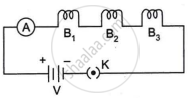 |
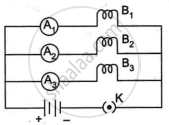 |
| Bulbs connected in series | Bulbs connected in parallel |
Let us assume that the resistance of each bulb is R.
In series:
Current in each bulb = `"V"/(3"R")`
In Parallel:
Net current =`(3"V")/"R"`
Current will get equally divided in three bulb `= "I"/3 = "V"/"R"`
- In a series combination, the potential difference gets divided, whereas, in parallel, the potential difference across each bulb remains full. Hence, in series, bulbs glow with less brightness than bulbs in parallel connection.
- Now, if one bulb gets fused in a series connection, all the other bulbs will stop glowing, whereas in a parallel connection, other bulbs will continue to glow. This is because in a series combination, even a single faulty component breaks the circuit, whereas this does not happen in a parallel circuit.
APPEARS IN
संबंधित प्रश्न
Why does the cord of an electric heater not glow while the heating element does?
An electric heater of resistance 8 Ω draws 15 A from the service mains 2 hours. Calculate the rate at which heat is developed in the heater.
Write Joule's law of heating.
An electric room heater draws a current of 2.4 A from the 120 V supply line. What current will this room heater draw when connected to 240 V supply line?
Explain why, the current that makes the heater element very hot, only slightly warms the connecting wires leading to the heater.
The heat produced in a wire of resistance 'x' when a current 'y' flows through it in time 'z' is given by:
(a) x2 × y × z
(b) x × z × y2
(c) y × z2 × x
(d) y × z × x
If the current flowing through a fixed resistor is halved, the heat produced in it will become:
Give Scientific reason.
In practice, the unit kWh is used for the measurement of electrical energy, rather than joule.
Identify the figure and give its use.

Write the mathematical expression for Joule’s law of heating.
Right or wrong sentence.
Live wire and neutral wires have a 220 V potential difference.
Write scientific reason.
A coil made up of alloy Nichrome is used in the electric heater cooker as a resistor.
Name any two appliances which work under the principle of heating effect of current.
The following is not a safety device.
A fuse is used in an electric circuit to stop high currents flowing through the circuit.
Explain why fuse wire is always connected in a series arrangement.
If 220 V potential difference is applied across an electric bulb, a current of 0.45 A flows in the bulb. What must be the power of the bulb?
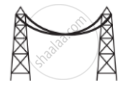
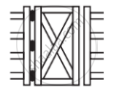
In which of the following applications of Iron, rusting will occur most? Support your answer with valid reason.
| A | B | C | D |
 |
 |
 |
 |
The graph of voltage vs current for four different materials is shown below.

Which of these four materials would be used for making filament of bulb?
