Advertisements
Advertisements
प्रश्न
Three incandescent bulbs of 100 W each are connected in series in an electric circuit. In another circuit another set of three bulbs of the same wattage are connected in parallel to the same source.
- Will the bulb in the two circuits glow with the same brightness? Justify your answer.
- Now let one bulb in both the circuits get fused. Will the rest of the bulbs continue to glow in each circuit? Give reason.
Advertisements
उत्तर
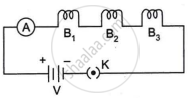 |
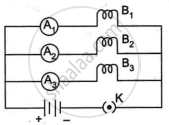 |
| Bulbs connected in series | Bulbs connected in parallel |
Let us assume that the resistance of each bulb is R.
In series:
Current in each bulb = `"V"/(3"R")`
In Parallel:
Net current =`(3"V")/"R"`
Current will get equally divided in three bulb `= "I"/3 = "V"/"R"`
- In a series combination, the potential difference gets divided, whereas, in parallel, the potential difference across each bulb remains full. Hence, in series, bulbs glow with less brightness than bulbs in parallel connection.
- Now, if one bulb gets fused in a series connection, all the other bulbs will stop glowing, whereas in a parallel connection, other bulbs will continue to glow. This is because in a series combination, even a single faulty component breaks the circuit, whereas this does not happen in a parallel circuit.
APPEARS IN
संबंधित प्रश्न
Why does the cord of an electric heater not glow while the heating element does?
Name any two effects of electric current.
Give two reasons why nichrome alloy is used for making the heating elements of electrical appliances.
Why is a series arrangement not used for connecting domestic electrical appliances in a circuit?
An electric iron of resistance 20 ohms draws a current of 5 amperes. Calculate the heat produced in 30 seconds.
How much heat will an instrument of 12 W produce in one minute if it is connected to the heat produced by it?
What is meant by the heating effect of current?
The current passing through an electric kettle has been doubled. The heat produced will become:
(a) half
(b) double
(c) four time
(d) one-fourth
Statement 1 : Electric current ( flow of electrons ) creates heat in the resistor.
Statement 2 : Heat in the resistor is created according to the rule of energy conservation.
Explain Statement 1 with the help of Statement 2.
Write scientific reason.
A coil made up of alloy Nichrome is used in the electric heater cooker as a resistor.
An electric iron consumes energy at the rate of 420 W when heating is at the maximum rate and 180 W when heating is at the minimum rate. The applied voltage is 220 V. What is the current in each case?
An electric kettle consumes 1 kW of electric power when operated at 220 V. A fuse wire of what rating must be used for it?
Unscramble the following words:
SFEU
What are the factors affecting heating effect of electric current?
A trip switch is a ______ safety device.
Explain why fuse wire is always connected in a series arrangement.
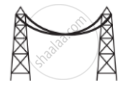
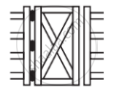
In which of the following applications of Iron, rusting will occur most? Support your answer with valid reason.
| A | B | C | D |
 |
 |
 |
 |
An electric iron is rated 220 V, 2 kW. If the iron is used for 3h daily find the cost of running it for one week if it costs ₹ 4.25 per kWh.
