Advertisements
Advertisements
Question
An electric iron consumes energy at the rate of 420 W when heating is at the maximum rate and 180 W when heating is at the minimum rate. The applied voltage is 220 V. What is the current in each case?
Advertisements
Solution
Case: 1
Power (P) = 420W
Applied Voltage (V) = 220V
Current \(\mathrm{I}=\frac{\mathrm{P}}{\mathrm{V}}=\frac{420}{220}=1.9 \mathrm{A}\)
Case: 2
Power (P) = 180 W
Applied Voltage (V) = 2.20 V
Current \(\mathrm{I}=\frac{\mathrm{P}}{\mathrm{V}}=\frac{180}{220}=0.8 \mathrm{A}\)
APPEARS IN
RELATED QUESTIONS
Three heaters each rated 250 W, 100 V are connected in parallel to a 100 V supply. Calculate:
- the total current taken from the supply
- the resistance of each heater and
- the energy supplied in kWh to the three heaters in 5 hours.
Write two devices based on the heating effect of electric current.
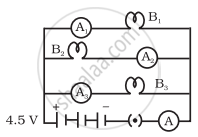
B1, B2 and B3 are three identical bulbs connected as shown in Figure. When all the three bulbs glow, a current of 3A is recorded by the ammeter A.
- What happens to the glow of the other two bulbs when the bulb B1 gets fused?
- What happens to the reading of A1, A2, A3 and A when the bulb B2 gets fused?
- How much power is dissipated in the circuit when all the three bulbs glow together?
An electric fuse has a body made of ceramic and two points for connecting the fuse wire.
Assertion: A current-carrying wire should be charged.
Reason: The current in a wire is due to the flow of free electrons in a definite direction.
A fuse is used in an electric circuit to stop high currents flowing through the circuit.
If 220 V potential difference is applied across an electric bulb, a current of 0.45 A flows in the bulb. What must be the power of the bulb?
Tara, after completing her exams, went to her grandmother's house along with her younger brother Rahul. One day, Rahul came home after playing and switched on the fan and air conditioner. At the same time, his grandmother was preparing a milkshake for him using a mixer. Suddenly, they heard a big sound and the electricity of the house got shut down. Tara is called an electrician. He said the main reason for supply to shut down was overloading.
- What is overloading?
- Is overloading and short the same? When does short-circuiting take place?
- How can the effects of overloading be avoided?
An electric kettle of 2 kW is used for 2h. Calculate the energy consumed in
- kilowatt hour and
- joules.
What is the heating effect of electric current?
