Advertisements
Advertisements
Question
State Ohm’s law? How can it be verified experimentally? Does it hold good under all conditions? Comment.
Advertisements
Solution
Ohm's Law states that at constant temperature, potential difference across a conductor is directly proportional to the current passing through it.
Mathematically
V ∝ I
`"V"/"I" = "R"`
where,
V = potential difference
I = current
R = Constant of proportionality and it is called Resistance
Experimental verification of Ohm's law:
Material needed: a nichrome wire, an ammeter, a voltmeter, three cells, key etc.,
Procedure:
- Create a circuit as shown in the diagram, consisting of a nichrome wire XY of length, say 0.4 m, an ammeter, a voltmeter and three cells of 1 V each. Place all the equipment properly.
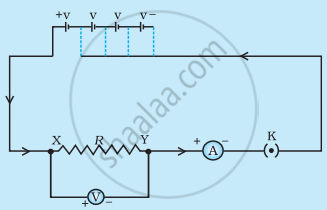
- First use only one cell as the source in the circuit. Note the reading in the ammeter I, for the current and reading of the voltmeter V for the potential difference across the nichrome wire XY in the circuit. Mark the corresponding readings in the Table given.
- Now connect two cells in the circuit and note the respective readings of the ammeter and voltmeter for the values of current through the nichrome wire and potential difference across the nichrome wire.
- Calculate the ratio of potential difference V to current I for each step.
Then plot the graph between potential difference and the current.
The graph between potential difference and the current is observed to be a straight line passing through origin. The slope of V-I graph indicates the resistance of the circuit. This verifies Ohm's law.S. No. Number of cells used in the circuit Current through the nichrome wire, I (ampere) Potential difference across the nichrome wire, V (volt) V/I
(volt/ampere)
1 1 2 2 3 3 4 4 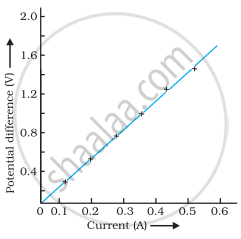
Ohm's law does not hold good under all conditions. It is obeyed by metallic conductors only when physical conditions like temperature etc. are kept unchanged and ideal. It is not obeyed by semiconductors, junction diode, thermistor etc. These are called non-ohmic conductors.
APPEARS IN
RELATED QUESTIONS
What will be the change in the current if the potential difference is kept constant and the resistance of the circuit is made four times?
- It will remain unchanged.
- It will become four times.
- It will become one-fourth.
- It will become half.
Will current flow more easily through a thick wire or a thin wire of the same material, when connected to the same source? Why?
Write the formula of resistivity
An electrical bulb is marked 200V, 100W. Calculate the electrical resistance of its filament. If five such
bulbs are connected in series to a 200V supply, how much current will flow through them?
Name the physical quantity whose unit is "ohm".
The unit of electrical resistance is:
(a) ampere
(b) volt
(c) coulomb
(d) ohm
State Ohm’s law and draw a neat labelled circuit diagram containing a battery, a key, a voltmeter, an ammeter, a rheostat and an unknown resistance to verify it.
In a conductor 6.25 × `10^16` electrons flow from its end A to B in 2 s. Find the current flowing through the conductor (e = 1.6 × `10^-19` C)
A wire of resistance 3 ohm and length 10 cm is stretched to length 30 cm. Assuming that it has a uniform cross section, what will be its new resistance?
What length of copper wire of resistivity 1.7 × 10⁻⁸ Ω m and radius 1 mm is required so that its resistance is 2Ω?
Show by a diagram how two resistors R1 and R2 are joined in parallel. Obtain an expression for the total resistance of the combination.
State and define Ohm’s law.
State the limitations of Ohm’s law.
What is non-ohmic resistor?
Ohm's Law states that for a metallic conductor, the current flowing through it is directly proportional to the potential difference across its ends, provided that:
In the context of Ohm's Law, Current (I) is defined as:
From Ohm's Law, since \[I \propto V\], the constant ratio \[\frac{V}{I}\] is defined as:
