Advertisements
Advertisements
Question
The heat produced by passing an electric current through a fixed resistor is proportional to the square of:
(a) magnitude of resistance of the resistor
(b) temperature of the resistor
(c) magnitude of current
(d) time for which current is passed
Advertisements
Solution
(c) magnitude of current
We know that:
H = I2Rt
It shows that the heat produced is proportional to the square of the current.
APPEARS IN
RELATED QUESTIONS
Write Joule's law of heating.
Why are the coils of electric irons and electric toasters made of an alloy rather than a pure metal?
How does the resistance of a wire vary with its:
diameter?
A resistance of 25 Ω is connected to a 12 V battery. Calculate the heat energy in joules generated per minute.
The current passing through a room heater has been halved. What will happen to the heat produced by it?
Give Scientific reason.
In practice, the unit kWh is used for the measurement of electrical energy, rather than joule.
Why does tungsten metal used to make solenoid type coil in an electric bulb?
The electricity bill specifies the usage in _______.
A coil of an alloy _______ is used in electric heater cooker as a resistor.
What is a short circuit?
What is used to turn off the sudden increase in current in the electrical circuit of the house nowadays?
Right or wrong sentence.
Live wire and neutral wires have a 220 V potential difference.
An electric iron draws a current of 4 A when connected to 220 V mains. Its resistance must be:
A current of 1 A is drawn by a filament of an electric bulb. Number of electrons passing through a cross-section of the filament in 16 seconds would be roughly:
An electric bulb is connected to a 220 V generator. The current is 0.50 A. What is the power of the bulb?
Assertion: Bending of wire decreases the resistance of the electric wire.
Reason: The resistance of a conductor depends on length, thickness, nature of material and temperature of the conductor.
An electric kettle consumes 1 kW of electric power when operated at 220 V. A fuse wire of what rating must be used for it?
Your teacher has shown you the following activity.
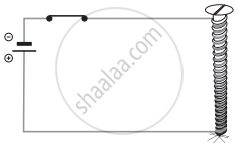
Activity: Teacher has wound a long insulated piece of wire around an iron nail in the form of a coil. Free ends of the wire are connected to a cell through a switch as shown in the following figure. The current is switched on and some pins are placed near the ends of the nail.
Write down any three questions that come to your mind about this activity.
Write an expression for the amount of heat produced in a resistor when an electric current is passed through it stating the meanings of the symbols used.
