Advertisements
Advertisements
Question
Name the factors on which the heat produced in a wire depends when current is passed in it, and state how does it depend on the factors stated by you.
Advertisements
Solution
Factors on which heat produced depends:
- On the current of wire: The square of the current l flowing through the wire is directly proportional to the heat H produced by the wire, i.e. H ∝ I2.
- On the resistance of wire: The wire's resistance, R, is directly proportional to the heat, H, that it generates. i.e. H ∝ R.
- On time: The quantity of heat H generated in the wire is proportionate to the duration t. during which current flows through it. i.e. H ∝ t.
From the above, H ∝ I2Rt or H =0.24 I2Rt.
APPEARS IN
RELATED QUESTIONS
Why does the connecting cord of an electric heater not glow hot while the heating element does?
If the current flowing through a fixed resistor is halved, the heat produced in it will become:
When does overloading occur?
Name any two appliances which work under the principle of heating effect of current.
An electric kettle consumes 1 kW of electric power when operated at 220 V. A fuse wire of what rating must be used for it?
(a) Observe the diagram given below and state whether the bulb will glow or not when we switch on K.
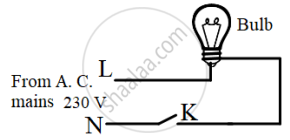
(b) Is it safe to handle the bulb when the switch is OFF?
(c) Give a reason for your answer in (b).
Can we use the same fuse in a geyser and a television set? Explain.
Explain the working of an electric fuse.
An electrochemical cell converts ______ energy into ______ energy.
State the law that explains the heating effect of current with respect to the measurable properties in an electrical circuit.
