Advertisements
Advertisements
Question
The ‘live’ and the ‘neutral’ wires have potential difference of _______.
Options
110 V
202 V
201 V
220 V
Advertisements
Solution
The ‘live’ and the ‘neutral’ wires have potential difference of 220 V.
APPEARS IN
RELATED QUESTIONS
State four most common electrical appliances based on heating effect of electric current. Why do we use finely heated platinum wire in surgery?
Name any two effects of electric current.
Write Joule's law of heating.
An electric heater is connected to the 230 V mains supply. A current of 8 A flows through the heater.
(b) How much energy is transferred to the heater each second?
An electric room heater draws a current of 2.4 A from the 120 V supply line. What current will this room heater draw when connected to 240 V supply line?
Explain why, tungsten is used for making the filaments of electric bulbs.
What is meant by the heating effect of current?
Which of the following characteristic is not suitable for a fuse wire?
(a) thin and short
(b) thick and short
(c) low melting point
(d) higher resistance than rest of wiring
Three heaters each rated 250 W, 100 V are connected in parallel to a 100 V supply. Calculate:
- the total current taken from the supply
- the resistance of each heater and
- the energy supplied in kWh to the three heaters in 5 hours.
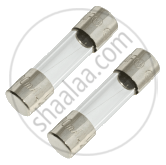
Identify the figure and give its use.
Heat energy is being produced in a resistance in a circuit at the rate of 100 W. The current of 3 A is flowing in the circuit. What must be the value of the resistance?
Solve the following example.
Two tungsten bulbs of wattage 100 W and 60 W power work on 220 V potential difference. If they are connected in parallel, how much current will flow in the main conductor?
Give scientific reason :
In the electric equipment producing heat e.g. iron, electric heater, boiler, toaster, etc., an alloy such as Nichrome is used, not pure metals.
Rewrite the following statement by selecting the correct option:
1 A = ____________ mA.
A coil of an alloy _______ is used in electric heater cooker as a resistor.
Which of the following substance contracts on heating?
What is a short circuit?
Name any two appliances which works on the phenomenon of heating effect of electric current.
Define fuse.
An electric iron consumes energy at the rate of 420 W when heating is at the maximum rate and 180 W when heating is at the minimum rate. The applied voltage is 220 V. What is the current in each case?
An electric iron draws a current of 4 A when connected to 220 V mains. Its resistance must be:
A fuse wire repeatedly gets burnt when used with a good heater. It is advised to use a fuse wire of:
A current of 1 A is drawn by a filament of an electric bulb. Number of electrons passing through a cross-section of the filament in 16 seconds would be roughly:
What are the factors affecting heating effect of electric current?
Explain the working of an electric fuse.
Fuse is a strip of alloy wire which is made up of lead and tin with a very low ______.
The following is not a safety device.
Explain why fuse wire is always connected in a series arrangement.
Define the following:
Electrolyte
If 220 V potential difference is applied across an electric bulb, a current of 0.45 A flows in the bulb. What must be the power of the bulb?
Find the odd one out.
In a set up the students coated iron nails with zinc metal and noted that, iron nails coated with zinc prevents rusting. They also observed that zinc initially acts as a physical barrier, but an extra advantage of using zinc is that it continues to prevent rusting even if the layer of zinc is damaged. Name this process of rust prevention and give any two other methods to prevent rusting.
An electric kettle of 2 kW is used for 2h. Calculate the energy consumed in
- kilowatt hour and
- joules.
State the law that explains the heating effect of current with respect to the measurable properties in an electrical circuit.
An electric iron of resistance 20 Ω draws a current of 5 A. The heat developed in the iron in 30 seconds is ______.
An electric iron is rated 220 V, 2 kW. If the iron is used for 3h daily find the cost of running it for one week if it costs ₹ 4.25 per kWh.
