Advertisements
Advertisements
Question
Give scientific reason :
In the electric equipment producing heat e.g. iron, electric heater, boiler, toaster, etc., an alloy such as Nichrome is used, not pure metals.
Advertisements
Solution
Resistivity of alloys like nichrome is more than pure metals so they will get heated easily on the passage of a small amount of current. They also have a high melting point and do not oxidize readily at high temperature. So in the electric equipment producing heat e.g. iron, electric heater, boiler, toaster etc, an alloy such as Nichrome is used, not pure metals.
APPEARS IN
RELATED QUESTIONS
State four most common electrical appliances based on heating effect of electric current. Why do we use finely heated platinum wire in surgery?
Why does the cord of an electric heater not glow while the heating element does?
An electric iron of resistance 20 Ω takes a current of 5 A. Calculate the heat developed in 30 s.
Why are the conductors of electric heating devices, such as bread-toasters and electric irons, made of an alloy rather than a pure metal?
How does the resistance of a wire vary with its area of cross-section?
An electric heater is connected to the 230 V mains supply. A current of 8 A flows through the heater.
(b) How much energy is transferred to the heater each second?
What is nichrome? State its one use.
Why is a series arrangement not used for connecting domestic electrical appliances in a circuit?
Explain why, tungsten is used for making the filaments of electric bulbs.
Name the material which is used for making the filaments of an electric bulb.
The heat produced in a wire of resistance 'x' when a current 'y' flows through it in time 'z' is given by:
(a) x2 × y × z
(b) x × z × y2
(c) y × z2 × x
(d) y × z × x
Which of the following characteristic is not suitable for a fuse wire?
(a) thin and short
(b) thick and short
(c) low melting point
(d) higher resistance than rest of wiring
Two exactly similar heating resistances are connected (i) in series, and (ii) in parallel, in two different circuits, one by one. If the same current is passed through both the combinations, is more heat obtained per minute when they are connected in series or when they are connected in parallel? Give reason for your answer.
Identify the figure and give its use.
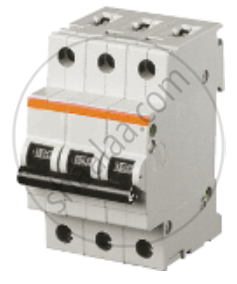
An electric iron of 1100 W is operated for 2 hrs daily. What will be the electrical consumption expenses for that in the month of April? (The electric company charges Rs 5 per unit of energy).
Why does tungsten metal used to make solenoid type coil in an electric bulb?
Answer the following question:
what is the heating effect of the electric current? state any four applications of it?
These days when current in the circuit suddenly increases _______ switches are used.
Which of the following substance contracts on heating?
When does overloading occur?
How can overloading be avoided?
The heating element of an electric iron is made up of:
Assertion: Bending of wire decreases the resistance of the electric wire.
Reason: The resistance of a conductor depends on length, thickness, nature of material and temperature of the conductor.
Three incandescent bulbs of 100 W each are connected in series in an electric circuit. In another circuit another set of three bulbs of the same wattage are connected in parallel to the same source.
- Will the bulb in the two circuits glow with the same brightness? Justify your answer.
- Now let one bulb in both the circuits get fused. Will the rest of the bulbs continue to glow in each circuit? Give reason.
What is Joule’s heating effect? How can it be demonstrated experimentally? List its four applications in daily life.
An MCB can be used instead of a fuse in an electrical circuit.
What is an electric fuse made up of?
It would cost a man Rs. 3.50 to buy 1.0 kW h of electrical energy from the Main Electricity Board. His generator has a maximum power of 2.0 kW. The generator produces energy at this maximum power for 3 hours. Calculate how much it would cost to buy the same amount of energy from the Main Electricity Board.
The following is not a safety device.
The electric fuse works on the Joule heating principle.
1 kWh is equal to ______.
An electric kettle of 2 kW is used for 2h. Calculate the energy consumed in
- kilowatt hour and
- joules.
When a current I flows through a wire of resistance R for time t then the electrical energy produced is given by ______.
An electric iron is rated 220 V, 2 kW. If the iron is used for 3h daily find the cost of running it for one week if it costs ₹ 4.25 per kWh.
