Advertisements
Advertisements
Question
Two tungsten bulbs of power 50 W and 60 W work on 220 V potential difference. If they are connected in parallel, how much current will flow in the main conductor?
Advertisements
Solution
Given: P1 = 50 W, P2 = 60 W and V = 220 V
To find I = ?
Formula: P = VI
We know,
Total Power (P) = P1 + P2
= 50 + 60
= 110 W
We know, P = VI
⇒ I = `"P"/"V"`
= `110/220`
= `1/2`
I = 0.5 A
The current of 0.5 A will flow in the main conductor.
APPEARS IN
RELATED QUESTIONS
What do the following symbols mean in circuit diagrams?
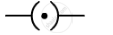
Draw circuit symbols for
a battery of three cells
Draw circuit symbols for
an open switch
Draw circuit symbols for
A closed switch
Draw a circuit diagram to show how 3 bulbs can be lit from a battery so that 2 bulbs are controlled by the same switch the third bulb has its own switch.
How does the short circuit form?
The following figure shows the symbols for components used in the accompanying electrical circuit. Place them at proper places and complete the circuit.
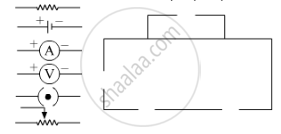
Which law can you prove with the help of above circuit?
A battery is to be formed by joining 3 dry cells with connecting wires. Show how will you connect the wires by drawing a diagram.
Answer the following question.
With the help of a suitable circuit diagram prove that the reciprocal of the equivalent resistance of a group of resistances joined in parallel is equal to the sum of the reciprocals of the individual resistances.
Draw a neat diagram showing a closed electric circuit.
Name the instrument used to control current in an electric circuit.
If you touch an electric wire carrying current you get a shock, but if on the same wire the birds sit they do not get any shock/current. Explain why?
Find the odd one out and give its explanation.
______ is the device used to close or open an electric circuit.
Rahul wants to make an electric circuit. He has a bulb, two wires, a safety pin, and a piece of copper. He does not have any electric cell or battery. Suddenly he gets some idea. He uses lemon instead of a battery and makes a circuit. Will the bulb glow?
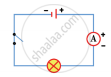
In the circuit diagram below, 10 units of electric charge move past point x every second What is the current in the circuit ______.
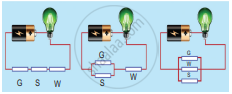
Study the three electric circuits below. Each of them has a glass rod (G), a steel rod (S), and a wooden rod (W).
In which of the electric circuits would the bulb not light up.
Assertion: People struck by lightning receive a severe electrical shock.
Reason: Lightning carries very high voltage.
What is electric circuit?
In a simple circuit, why does the bulb glow when you close the switch?
Instead of metal wires, a jute string can be used to make a circuit.
The rate of flow of electric charges in a circuit is called ______.
______ is a kind of fish which is able to produce an electric current.
In a circuit, if the key is in open (off) condition, then electricity will not flow.
In an electrical circuit two resistors of 2 Ω and 4 Ω respectively are connected in series to a 6 V battery. The heat dissipated by the 4 Ω resistor in 5 s will be
In an electric circuit, the current starts from ______.
Our body is a ______ of electricity.
Draw the symbols of the following circuit components.
Switch in off position

In the above circuit, if the current reading in the ammeter A is 2A, what would be the value of R1?
Match the following
| 1. | Insulator | a. | Coulomb |
| 2. | Conductor | b. | Electric circuit |
| 3. | Closed path | c. | Copper |
| 4. | Electric charge | d. | Rubber |
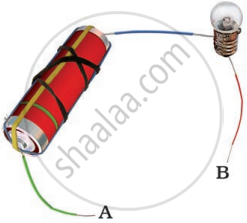
In the following arrangement shown in the following figure, the bulb will not glow if the ends A and B are connected with
Boojho has a cell and a single piece of connecting wire. Without cutting the wire in two, will he be able to make the bulb glow? Explain with the help of a circuit diagram.
Write a short note on the different electrical circuits.
Name the device which is used to measure the strength of the electric current in an electric circuit.
A complete circuit is left on for several minutes, causing the connecting copper wire to become hot. As the temperature of the wire increases, the electrical resistance of the wire
