Advertisements
Advertisements
Question
Draw a circuit diagram of an electric circuit containing a cell, a key, an ammeter, a resistor of 2 Ω in series with a combination of two resistors (4 Ω each) in parallel and a voltmeter across the parallel combination. Will the potential difference across the 2 Ω resistor be the same as that across the parallel combination of 4 Ω resistors? Give reason.
Advertisements
Solution

Yes, the potential difference across the 2 Ω resistor will be the same as that across the parallel combination of 4 Ω resistors because net resistance of parallel combination
= `(4 xx 4)/(4 + 4)`
= 2 Ω
and current across 2 Ω and parallel combination is the same.
APPEARS IN
RELATED QUESTIONS
Draw circuit symbols for variable resistance
Draw circuit symbols for
a cell
Observe the following figure which bulb get fuse?

The following figure shows the symbols for components used in the accompanying electrical circuit. Place them at proper places and complete the circuit.
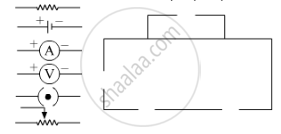
Which law can you prove with the help of above circuit?
Resistances R1, R2, R3 and R4 are connected as shown in the figure. S1 and S2 are two keys. Discuss the current flowing in the circuit in the following cases.
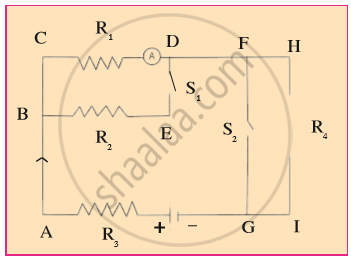
- Both S1 and S2 are closed.
- Both S1 and S2 are open.
- S1 is closed but S2 is open.
Match the column ‘A’ with column ‘B’.
|
Column ‘A’
|
Column ‘B’ |
|
(1) Eka - boron
|
(a) Germanium
|
|
(2) Eka - Aluminium
|
(b) Scandium
|
|
(3) Eka - Silicon
|
(c) Gallium |
Answer the following question.
With the help of a suitable circuit diagram prove that the reciprocal of the equivalent resistance of a group of resistances joined in parallel is equal to the sum of the reciprocals of the individual resistances.
In any electric circuit, when the switch is on and the current flows through it why do the wire, switches, bulb or devices become hot?
Flow of electricity through a closed circuit is _____.
The wiring in a house consists of ______ circuits.
A device that is used to break an electric circuit is called ______.
Instead of metal wires, a jute string can be used to make a circuit.
A child has drawn the electric circuit to study Ohm’s law as shown in Figure. His teacher told that the circuit diagram needs correction. Study the circuit diagram and redraw it after making all corrections.

Our body is a ______ of electricity.

In the above circuit, if the current reading in the ammeter A is 2A, what would be the value of R1?
Boojho has a cell and a single piece of connecting wire. Without cutting the wire in two, will he be able to make the bulb glow? Explain with the help of a circuit diagram.
How is Joule's law effect useful in electric circuits where fuse is used as a safety device?
Set up the circuit shown in Figure again. Move the key to ‘ON’ position and watch carefully in which direction the compass needle gets deflected. Switch ‘OFF’ the current. Now keeping rest of the circuit intact, reverse the connections at the terminal of the cell. Again switch ‘on’ the current. Note the direction in which the needle gets deflected. Think of an explanation.