Advertisements
Advertisements
Question
How is Joule's law effect useful in electric circuits where fuse is used as a safety device?
Advertisements
Solution
Joule’s heating is the fuse used in electric circuits. It protects circuits and appliances by stopping unduly high electric current flow. The fuse is placed in series with the device. It consists of a piece of wire made of a metal or an alloy of appropriate melting point, for example, aluminium, copper, iron, lead, etc. If a current larger than the specified value flows through the circuit, the temperature of the fuse wire increases. This melts the fuse wire and breaks the circuit. The fuse wire is usually encased in a cartridge of porcelain or similar material with metal ends. The fuses used for domestic purposes are rated as 1 A, 2 A, 3 A, 5 A, 10 A, etc.
APPEARS IN
RELATED QUESTIONS
In an electric circuit, a battery and a bulb have been connected and the battery consists of two cells of equal potential difference. If the bulb is not glowing, then which tests will you perform in order to find out the reason for the bulb not glowing?
Right or wrong sentence.
Increasing the current passing through the wire decreases the magnetic field intensity.
Flow of electricity through a closed circuit is _____.
______ is the device used to close or open an electric circuit.
Rahul wants to make an electric circuit. He has a bulb, two wires, a safety pin, and a piece of copper. He does not have any electric cell or battery. Suddenly he gets some idea. He uses lemon instead of a battery and makes a circuit. Will the bulb glow?
_____ has a thin metallic filament that melts and breaks the connection when the circuit is overheated.
Instead of metal wires, a jute string can be used to make a circuit.
The ______ is a species of fish that can give electric shocks of up to six hundred fifty watts of electricity.
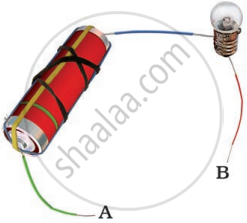
In the following arrangement shown in the following figure, the bulb will not glow if the ends A and B are connected with
Set up the circuit shown in Figure again. Move the key to ‘ON’ position and watch carefully in which direction the compass needle gets deflected. Switch ‘OFF’ the current. Now keeping rest of the circuit intact, reverse the connections at the terminal of the cell. Again switch ‘on’ the current. Note the direction in which the needle gets deflected. Think of an explanation.