Advertisements
Advertisements
Question
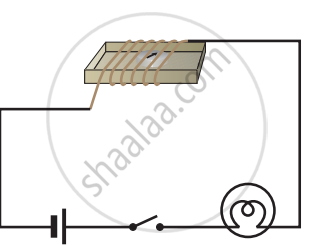
Set up the circuit shown in Figure again. Move the key to ‘ON’ position and watch carefully in which direction the compass needle gets deflected. Switch ‘OFF’ the current. Now keeping rest of the circuit intact, reverse the connections at the terminal of the cell. Again switch ‘on’ the current. Note the direction in which the needle gets deflected. Think of an explanation.
Advertisements
Solution

- Set up the Circuit:
- Connect the components as shown in the figure: battery, switch, wire wound around cardboard, and a compass.
- Turn the Switch 'ON':
- Close the switch to 'ON'.
- Observe and note the direction of the compass needle deflection.
- Turn the Switch 'OFF':
- Open the switch to 'OFF'.
- Reverse Battery Connections:
- Swap the positive and negative terminals of the battery.
- Turn the Switch 'ON' Again:
- Close the switch to 'ON'.
- Observe and note the direction of the compass needle deflection again.
- Explanation:
- The compass needle deflects due to the magnetic field created by the current.
- Reversing the battery connections reverses the current direction, thus reversing the magnetic field and the needle's deflection direction.
APPEARS IN
RELATED QUESTIONS
Draw a schematic diagram of a circuit consisting of a battery of three cells of 2 V each, a 5 Ω resistor, an 8 Ω resistor, and a 12 Ω resistor, and a plug key, all connected in series.
Explain with the help of a labelled circuit diagram how you will find the resistance of a combination of three resistors, or resistance R1, R2 and R3, joined in parallel. Also mention how you will connect the ammeter and the voltmeter in the circuit when measuring the current in the circuit and the potential difference across one of the three resistors of the combination.
Name the instrument used to control current in an electric circuit.
In any electric circuit, when the switch is on and the current flows through it why do the wire, switches, bulb or devices become hot?
What is the use of earthing wire?
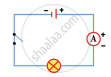
In the circuit diagram below, 10 units of electric charge move past point x every second What is the current in the circuit ______.
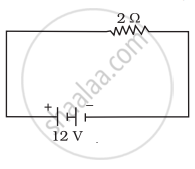
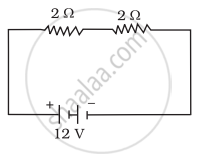
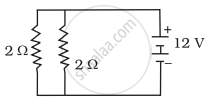
In the following circuits (Figure), heat produced in the resistor or combination of resistors connected to a 12 V battery will be
 |
 |
 |
| (i) | (ii) | (iii) |
Choose the statement which is not correct in the case of an electric fuse.
What are the essential components of an electric circuit?
Overloading of electric circuits can lead to short-circuiting.
