English

Make four electromagnets with 20, 40, 60 and 80 turns. Connect them one by one to a battery of 2 cells. Bring the electromagnet near a box of pins. Count the number of pins

Advertisements
Advertisements

Question

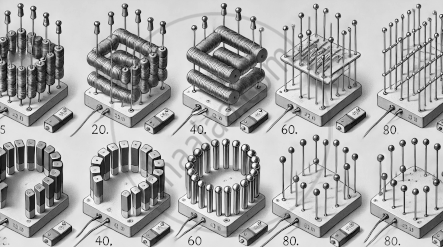
Make four electromagnets with 20, 40, 60 and 80 turns. Connect them one by one to a battery of 2 cells. Bring the electromagnet near a box of pins. Count the number of pins attracted by it. Compare the strengths of the electromagnets.

Answer in Brief
Advertisements

Solution

Experiment Steps and Observations:

  1. Materials Needed:

    • Coils with 20, 40, 60, and 80 turns.
    • Battery (2 cells).
    • Box of pins.
  2. Procedure:

    • Wind the coils around an iron core to create electromagnets.
    • Connect each coil to the battery one by one.
    • Bring each electromagnet near the box of pins and count the pins attracted.
  3. Observations:

    • 20 turns: Attracts a small number of pins.
    • 40 turns: Attracts more pins than the 20-turn coil.
    • 60 turns: Attracts even more pins.
    • 80 turns: Attracts the most pins.

Result:

Number of Turns Pins Attracted
20 Few pins
40 More pins
60 Even more pins
80 Most pins

Conclusion:

The strength of the electromagnet increases with the number of turns in the coil. Therefore, the electromagnet with 80 turns is the strongest, followed by those with 60, 40, and 20 turns.

Visual Representation:

The provided image shows the electromagnets with different turns and the pins they attract, illustrating the increasing strength with more turns.

shaalaa.com
  Is there an error in this question or solution?
Chapter 10: Electric Current and Its Effects - Activities and Projects [Page 122]

APPEARS IN

NCERT Science [English] Class 7
Chapter 10 Electric Current and Its Effects
Activities and Projects | Q 2. | Page 122

RELATED QUESTIONS

If the direction of electric current in a solenoid when viewed from a particular end is anticlockwise, then this end of solenoid will be:

(a) west pole
(b) south pole
(c) north pole
(d) east pole


For the coil in the diagram below, when the switch is pressed:

(a) what is the polarity of end A?
(b) which way will the compass point then?    


 What device reverses the current?


Write the correct option by observing the figures.


In the Activity shown below, how do we think the displacement of rod AB will be affected if

  1. current in rod AB is increased
  2. a stronger horse-shoe magnet is used
  3. length of the rod AB is increased?
  • Take a small aluminium rod AB (of about 5 cm). Using two connecting wires suspend it horizontally from a stand, as shown in Fig.
  • Place a strong horse-shoe magnet in such a way that the rod lies between the two poles with the magnetic field directed upwards. For this put the north pole of the magnet vertically below and south pole vertically above the aluminium rod (Fig.).
  • Connect the aluminium rod in series with a battery, a key and a rheostat.
  • Now pass a current through the aluminium rod from end B to end A.
  • What do you observe? It is observed that the rod is displaced towards the left. You will notice that the rod gets displaced.
  • Reverse the direction of current flowing through the rod and observe the direction of its displacement. It is now towards the right.
  • Why does the rod get displaced?


A current-carrying rod, AB, experiences a force perpendicular to its length and the magnetic field. Support for the magnet is not shown here, for simplicity.


Read the given passage and answer the following questions:

The home electrical connection consists of ‘live’, ‘neutral’ and ‘earth’ wires. The ‘live’ and the ‘neutral’ wires have potential difference of 220 V. The ‘earth’ is connected to ground. Due to a fault in the equipment or if the plastic coating on the ‘live’ and the ‘neutral’ wires gives a way the two wires come in contact with each other and a large current flows through it producing heat. If any inflammable material (such as wood, cloth, plastic, etc.) exists around that place it can catch fire. Therefore a fuse wire is used as a precautionary measure.

  1. Name the two wires having potential difference of 220 V.
  2. What is a short circuit?
  3. Write the function of a fuse.

A magnetic compass shows a deflection when placed near a current carrying wire. How will the deflection of the compass get affected if the current in the wire is increased? Support your answer with a reason.


Why do we cover plug pin holes which are within the reach of children with cellotape or a plastic cover when not in use?


What do you mean by the magnetic effect?


As shown in the diagram an aluminium rod 'AB' is suspended horizontally between the two poles of a strong horse shoe magnet in such a way that the axis of rod is horizontal and the direction of the magnetic field is vertically upward. The rod is connected in series with a battery and a key.

State giving reason:

  1. What is observed when a current is passed through the aluminium rod from end B to end A?
  2. What change is observed in a situation in which the axis of the rod 'AB' is moved and aligned parallel to the magnetic field and current is passed in the rod in the same direction?

Share
Notifications

Englishहिंदीमराठी


      Forgot password?
Use app×