English

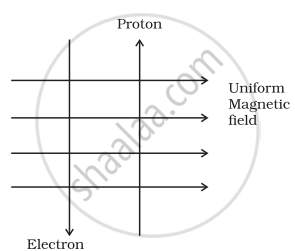
A uniform magnetic field exists in the plane of paper pointing from left to right as shown in Figure. In the field an electron and a proton move as shown. The electron and the proton experience - Science

Advertisements
Advertisements

Question

A uniform magnetic field exists in the plane of paper pointing from left to right as shown in Figure. In the field an electron and a proton move as shown. The electron and the proton experience

Options

  • forces both pointing into the plane of paper

  • forces both pointing out of the plane of paper

  • forces pointing into the plane of paper and out of the plane of paper, respectively

  • force pointing opposite and along the direction of the uniform magnetic field respectively

MCQ
Advertisements

Solution

forces both pointing into the plane of paper

Explanation - 

The direction of the current is taken as opposite to the flow of electron or in the direction of the flow of protons.

In the given figure, the proton and electron are moving in the opposite direction to each other and perpendicular to the direction of the magnetic field. So, current due to both electron and proton are in the same direction. Hence, the forces acting on both will be in the same direction. By Fleming's left-hand rule the direction of force is pointing into the plane of the paper.
shaalaa.com
  Is there an error in this question or solution?
Chapter 13: Magnetic Effects of Electric Current - Multiple Choice Questions [Page 98]

APPEARS IN

NCERT Exemplar Science [English] Class 10
Chapter 13 Magnetic Effects of Electric Current
Multiple Choice Questions | Q 5. | Page 98

RELATED QUESTIONS

Which effect of current can be utilised in detecting a current carrying wire concealed in a wall? 


Name the scientist who discovered the magnetic effect of current.


Fill in the following blank with suitable words: 

The magnetic effect of a coil can be increased by increasing the number of ........... increasing the ........... or inserting an ........... core.


Fill in the following blank with suitable words:

 If a coil is viewed from one end and the current flows in an anticlockwise direction, then this end is a ........... pole.


The magnetic effect of current was discovered by:

(a) Maxwell
(b) Fleming
(c) Oersted
(d) Faraday


For the coil in the diagram below, when the switch is pressed:

(a) what is the polarity of end A?
(b) which way will the compass point then?    


The direction of current flowing in the coil of an electromagnet at its two ends X and Y are as shown below:  


 What is the polarity of end X?

What is the polarity of end Y?   

Name and state the rule which you have used to determine the polarities. 


Name one device which works on the magnetic effect of current.


A coil is connected to a galvanometer. When the N-pole of magnet is pushed into the coil, the galvanometer deflected to the right. What deflection, if any, is observed when:  

 the N-pole is removed?


If fuse of 250 mA, 500 mA, 1 A, 5 A and 10 A were available, which one would be the most suitable for protecting an amplifier rated at 240 V, 180 W?  


How should the electric lamps in a building be connected so that the switching on or off in a room has no effect on other lamps in the same building?


(b) State whether the following statements are true or false:

(i) Magnetic poles exist in pairs.

(ii) Global warming is a desirable aspect of the intensified greenhouse effect.


Name any two appliances which works on the phenomenon of magnetic effect of electric current.


Draw a neat labelled diagram to show the magnetic effect of electric current.


Identify the given figure, write the labels of it.


A magnetic compass shows a deflection when placed near a current carrying wire. How will the deflection of the compass get affected if the current in the wire is increased? Support your answer with a reason.


Magnetic effect of current was discovered by ______.


______ are also used to remove splinters of steel or iron in hospitals dealing with eye injuries.


Edison used a ______ wire coil is a vacuum glass and discovered the first electric bulb in 1879.


Share
Notifications

Englishहिंदीमराठी


      Forgot password?
Use app×