Advertisements
Advertisements
Question
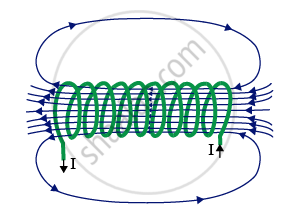
For a current in a long straight solenoid N- and S-poles are created at the two ends. Among the following statements, the incorrect statement is
Options
The field lines inside the solenoid are in the form of straight lines which indicates that the magnetic field is the same at all points inside the solenoid
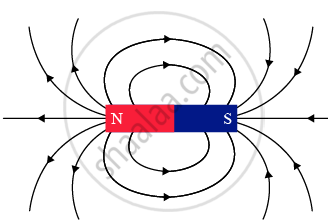
The pattern of the magnetic field associated with the solenoid is different from the pattern of the magnetic field around a bar magnet
The N- and S-poles exchange position when the direction of current through the solenoid is reversed
Advertisements
Solution
The pattern of the magnetic field associated with the solenoid is different from the pattern of the magnetic field around a bar magnet
Explanation -
Option (a), (b) and (d) are correct. Only option (c) is incorrect because the pattern of magnetic fields due to solenoid and bar magnet is almost the same.
APPEARS IN
RELATED QUESTIONS
When is the force experienced by a current-carrying conductor placed in a magnetic field largest?
State Fleming’s left hand rule.
State whether the following statement is true or false:
The magnetic field inside a long circular coil carrying current well be parallel straight lines.
Name and state the rule to determine the direction of magnetic field around a straight current-carrying conductor.
Draw the magnetic lines of force due to a circular wire carrying current.
A current-carrying straight wire is held in exactly vertical position. If the current passes through this wire in the vertically upward direction, what is the direction of magnetic field produced by it? Name the rule used to find the direction of magnetic field.
A current-carrying conductor is held in exactly vertical direction. In order to produce a clockwise magnetic field around the conductor, the current should passed in the conductor:
(a) from top towards bottom
(b) from left towards right
(c) from bottom towards top
(d) from right towards left
A current-carrying conductor is placed perpendicularly in a magnetic field. Name the rule which can be used to find the direction of force acting on the conductor.
Name one device whose working depends on the force exerted on a current-carrying coil placed in a magnetic field.
What is the force on a current-carrying wire that is parallel to a magnetic field? Give reason for your answer.
A flat coil ABCD is freely suspended between the pole of U-shaped permanent magnet with the plane of coil parallel to the magnetic field.
What happens when a current is passed in the coil?
State Fleming’s left-hand rule.
The strength of magnetic field around a current-carrying conductor is ____________.
When current is parallel to a magnetic field, then force experience by the current-carrying conductor placed in a uniform magnetic field is ____________.
The direction of force on a current carrying conductor in a magnetic field is given by ____________.
A copper wire is held between the poles of a magnet

The current in the wire can be reversed. The pole of the magnet can also be changed over. In how many of the four directions shown can the force act on the wire?
A copper conductor is placed over two stretched copper wires whose ends ate connected to a D.C. supply as shown in the diagram.
- What should be the magnetic poles at the points A and B lying on either side of the conductor to experience the force in the upward direction?
- Name the law used to find these polarities.

