Advertisements
Advertisements
प्रश्न
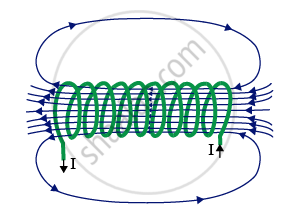
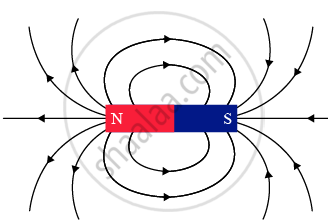
For a current in a long straight solenoid N- and S-poles are created at the two ends. Among the following statements, the incorrect statement is
विकल्प
The field lines inside the solenoid are in the form of straight lines which indicates that the magnetic field is the same at all points inside the solenoid
The pattern of the magnetic field associated with the solenoid is different from the pattern of the magnetic field around a bar magnet
The N- and S-poles exchange position when the direction of current through the solenoid is reversed
Advertisements
उत्तर
The pattern of the magnetic field associated with the solenoid is different from the pattern of the magnetic field around a bar magnet
Explanation -
Option (a), (b) and (d) are correct. Only option (c) is incorrect because the pattern of magnetic fields due to solenoid and bar magnet is almost the same.
APPEARS IN
संबंधित प्रश्न
Which of the following property of a proton can change while it moves freely in a magnetic field? (There may be more than one correct answer.)
State Fleming’s left hand rule.
State the form of magnetic field lines around a straight current-carrying conductor.
Fill in the following blank with suitable words:
For a current-carrying solenoid, the magnetic field is like that of a ...........
Name and state the rule to determine the direction of magnetic field around a straight current-carrying conductor.
Draw the magnetic lines of force due to a circular wire carrying current.
What are the various ways in which the strength of magnetic field produced by a current-carrying circular coil can be increased?
Name any two factors on which the strength of magnetic field produced by a current-carrying solenoid depends. How does it depend on these factors?
A current-carrying straight wire is held in exactly vertical position. If the current passes through this wire in the vertically upward direction, what is the direction of magnetic field produced by it? Name the rule used to find the direction of magnetic field.
A current-carrying conductor is placed perpendicularly in a magnetic field. Name the rule which can be used to find the direction of force acting on the conductor.
State Fleming's left-hand rule. Explain it with the help of labelled diagrams.
What is the force on a current-carrying wire that is parallel to a magnetic field? Give reason for your answer.
Name three factors on which the magnitude of force on a current carrying conductor placed in a magnetic field depends and state how does the force depend on the factors stated by you.
State condition when magnitude of force on a current carrying conductor placed in a magnetic field is maximum?
State the unit of magnetic field in terms of the force experienced by a current carrying conductor placed in a magnetic field
State under what conditions force acting on a current carrying conductor which is freely suspended in a magnetic field can be Zero.
Which of the following factors affect the strength of force experience by current-carrying conduct in a uniform magnetic field?
The direction of force on a current carrying conductor in a magnetic field is given by ____________.
What does the direction of thumb indicate in the right-hand thumb rule. In what way this rule is different from Fleming’s left-hand rule?
|
The graph (fig A) illustrates the correlation between the number of protons (x-axis) and the number of neutrons (y-axis) for elements A, B, C, D, and E in the periodic table. These elements are denoted by the letters rather than their conventional symbols. When the element C, depicted in the graph, undergoes radioactive decay, it releases radioactive rays. When these rays are directed into the plane of the paper in the presence of a magnetic field, as indicated in the fig B, they experience deflection, causing them to move upwards.
|
Name the law used to identify the radioactive radiation emitted by the element.

