Advertisements
Advertisements
प्रश्न
Make four electromagnets with 20, 40, 60 and 80 turns. Connect them one by one to a battery of 2 cells. Bring the electromagnet near a box of pins. Count the number of pins attracted by it. Compare the strengths of the electromagnets.
Advertisements
उत्तर
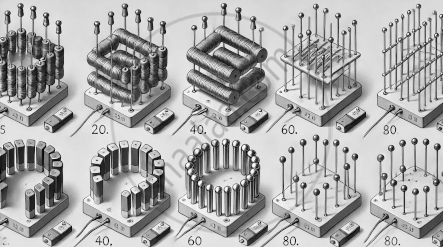
Experiment Steps and Observations:
-
Materials Needed:
- Coils with 20, 40, 60, and 80 turns.
- Battery (2 cells).
- Box of pins.
-
Procedure:
- Wind the coils around an iron core to create electromagnets.
- Connect each coil to the battery one by one.
- Bring each electromagnet near the box of pins and count the pins attracted.
-
Observations:
- 20 turns: Attracts a small number of pins.
- 40 turns: Attracts more pins than the 20-turn coil.
- 60 turns: Attracts even more pins.
- 80 turns: Attracts the most pins.
Result:
| Number of Turns | Pins Attracted |
| 20 | Few pins |
| 40 | More pins |
| 60 | Even more pins |
| 80 | Most pins |
Conclusion:
The strength of the electromagnet increases with the number of turns in the coil. Therefore, the electromagnet with 80 turns is the strongest, followed by those with 60, 40, and 20 turns.
Visual Representation:
The provided image shows the electromagnets with different turns and the pins they attract, illustrating the increasing strength with more turns.
APPEARS IN
संबंधित प्रश्न
An electromagnet does not attract a piece of iron.
An electric bell has an electromagnet.
The magnetic effect of current was discovered by ______.
The direction of current flowing in the coil of an electromagnet at its two ends X and Y are as shown below:
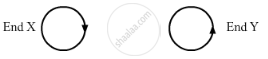
What is the polarity of end X?
What is the polarity of end Y?
Name and state the rule which you have used to determine the polarities.
What is the function of a split ring in an electric motor?
Magnetic effect of current was discovered by ______.
______ are also used to remove splinters of steel or iron in hospitals dealing with eye injuries.
What are MCBs? How do they work?
A wire with green insulation is usually the live wire of an electric supply.
A rectangular loop ABCD carrying a current I is situated near a straight conductor XY, such that the conductor is parallel to the side AB of the loop and is in the plane of the loop. If a steady current I is established in the conductor as shown, the conductor XY will ______.

