Advertisements
Advertisements
प्रश्न
Read the given passage and answer the following questions:
The home electrical connection consists of ‘live’, ‘neutral’ and ‘earth’ wires. The ‘live’ and the ‘neutral’ wires have potential difference of 220 V. The ‘earth’ is connected to ground. Due to a fault in the equipment or if the plastic coating on the ‘live’ and the ‘neutral’ wires gives a way the two wires come in contact with each other and a large current flows through it producing heat. If any inflammable material (such as wood, cloth, plastic, etc.) exists around that place it can catch fire. Therefore a fuse wire is used as a precautionary measure.
- Name the two wires having potential difference of 220 V.
- What is a short circuit?
- Write the function of a fuse.
Advertisements
उत्तर
- The ‘live’ and the ‘neutral’ wires have potential difference of 220 V.
- Due to a fault in the equipment or if the plastic coating on the ‘live’ and the ‘neutral’ wires gives away the two wires come in contact with each other and a large current flows through it producing heat. This is known as short circuiting.
- Fuse wire protects circuits and appliances by stopping the flow of any excess electric current.
APPEARS IN
संबंधित प्रश्न
When the current is switched on through a wire, a compass needle kept nearby gets deflected from its north-south position. Explain.
An electric bell has an electromagnet.
Do you think an electromagnet can be used for separating plastic bags from a garbage heap? Explain.
Fill in the following blank with suitable words:
The magnetic effect of a coil can be increased by increasing the number of ........... increasing the ........... or inserting an ........... core.
Describe some experiment to show that the magnetic field is associated with an electric current.
What device reverses the current?
The north pole of a long bar magnet was pushed slowly into a short solenoid connected to a galvanometer. The magnet was held stationary for a few seconds with the north pole in the middle of the solenoid and then withdrawn rapidly. The maximum deflection of the galvanometer was observed when the magnet was ______.
A coil is connected to a galvanometer. When the N-pole of magnet is pushed into the coil, the galvanometer deflected to the right. What deflection, if any, is observed when:
the N-pole is removed?
(b) State whether the following statements are true or false:
(i) Magnetic poles exist in pairs.
(ii) Global warming is a desirable aspect of the intensified greenhouse effect.
A soft iron bar is introduced inside the current-carrying solenoid. The magnetic field inside the solenoid ____________.
If the key in the given arrangement is taken out (the circuit is made open) and magnetic field lines are drawn over the horizontal plane ABCD, the lines are ____________.

What is that instrument which can detect the presence of electric current in a circuit?
In the arrangement shown in Figure there are two coils wound on a non-conducting cylindrical rod. Initially the key is not inserted. Then the key is inserted and later removed. Then

A magnetic compass shows a deflection when placed near a current carrying wire. How will the deflection of the compass get affected if the current in the wire is increased? Support your answer with a reason.
Why do we cover plug pin holes which are within the reach of children with cellotape or a plastic cover when not in use?
What are MCBs? How do they work?
A student was asked to perform an experiment to study the force on a current carrying conductor in a magnetic field. He took a small aluminium rod AB, a strong horse shoe magnet, some connecting wires, a battery and a switch and connected them as shown. He observed that on passing current, the rod gets displaced. On reversing the direction of current, the direction of displacement also gets reversed. On the basis of your understanding of this phenomenon, answer the following questions:
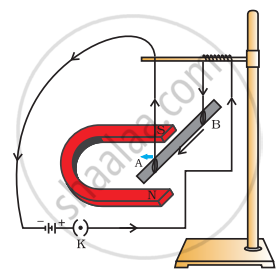
- Why does the rod get displaced on passing current through it?
- State the rule that determines the direction of the force on the conductor AB.
-
- If the U-shaped magnet is held vertically and the aluminium rod is suspended horizontally with its end B towards due north, then on passing current through the rod from B to A as shown, in which direction will the rod be displaced?
- Name any two devices that use current carrying conductors and magnetic fields.
OR
Draw the pattern of magnetic field lines produced around a current carrying straight conductor held vertically on a horizontal cardboard. Indicate the direction of the field lines as well as the direction of current flowing through the conductor.
As shown in the diagram an aluminium rod 'AB' is suspended horizontally between the two poles of a strong horse shoe magnet in such a way that the axis of rod is horizontal and the direction of the magnetic field is vertically upward. The rod is connected in series with a battery and a key.
State giving reason:
- What is observed when a current is passed through the aluminium rod from end B to end A?
- What change is observed in a situation in which the axis of the rod 'AB' is moved and aligned parallel to the magnetic field and current is passed in the rod in the same direction?
A rectangular loop ABCD carrying a current I is situated near a straight conductor XY, such that the conductor is parallel to the side AB of the loop and is in the plane of the loop. If a steady current I is established in the conductor as shown, the conductor XY will ______.

