Advertisements
Advertisements
प्रश्न
As shown in the diagram an aluminium rod 'AB' is suspended horizontally between the two poles of a strong horse shoe magnet in such a way that the axis of rod is horizontal and the direction of the magnetic field is vertically upward. The rod is connected in series with a battery and a key.
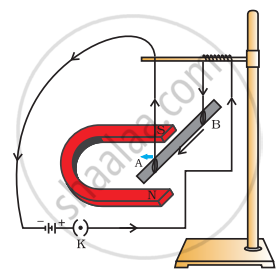
State giving reason:
- What is observed when a current is passed through the aluminium rod from end B to end A?
- What change is observed in a situation in which the axis of the rod 'AB' is moved and aligned parallel to the magnetic field and current is passed in the rod in the same direction?
संक्षेप में उत्तर
Advertisements
उत्तर
- The rods move if a current is sent through them from B to A. The force acting on the current carrying rod is what is responsible for this displacement. The rod is pulled to the left by the magnet, which causes a deflection of the rod in that direction.
- No change is observed when the axis of the rod "AB" is moved and aligned parallel to the magnetic field and current is passed in the rod in the same direction. Since there is no force, so their will be no motion.
shaalaa.com
क्या इस प्रश्न या उत्तर में कोई त्रुटि है?
