Advertisements
Advertisements
Question
Read the given passage and answer the following questions:
The home electrical connection consists of ‘live’, ‘neutral’ and ‘earth’ wires. The ‘live’ and the ‘neutral’ wires have potential difference of 220 V. The ‘earth’ is connected to ground. Due to a fault in the equipment or if the plastic coating on the ‘live’ and the ‘neutral’ wires gives a way the two wires come in contact with each other and a large current flows through it producing heat. If any inflammable material (such as wood, cloth, plastic, etc.) exists around that place it can catch fire. Therefore a fuse wire is used as a precautionary measure.
- Name the two wires having potential difference of 220 V.
- What is a short circuit?
- Write the function of a fuse.
Advertisements
Solution
- The ‘live’ and the ‘neutral’ wires have potential difference of 220 V.
- Due to a fault in the equipment or if the plastic coating on the ‘live’ and the ‘neutral’ wires gives away the two wires come in contact with each other and a large current flows through it producing heat. This is known as short circuiting.
- Fuse wire protects circuits and appliances by stopping the flow of any excess electric current.
APPEARS IN
RELATED QUESTIONS
Do you think an electromagnet can be used for separating plastic bags from a garbage heap? Explain.
Which effect of current can be utilised in detecting a current carrying wire concealed in a wall?
When the switch S is closed in the figure given below, the pointer of the galvanometer moves to the right.
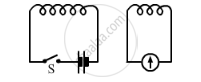
If S is kept closed, will the pointer:
(a) return to zero?
(b) stay over on the right?
(c) move to the left and stay there
(d) move to and fro until S is opened
How should the electric lamps in a building be connected so that the switching on or off in a room has no effect on other lamps in the same building?
Observe the following diagram and choose the correct alternative:

(b) State whether the following statements are true or false:
(i) Magnetic poles exist in pairs.
(ii) Global warming is a desirable aspect of the intensified greenhouse effect.
(c) Considering the relationship in the first pair, complete the second paie :
AgCI : White :: CuI2 : ___________
(ii) Global warming is a desirable aspect of the intensified greenhouse effect.
Draw a neat labelled diagram to show the magnetic effect of electric current.
Explain the magnetic field created by a current around a conductor from the figure.
A soft iron bar is introduced inside the current-carrying solenoid. The magnetic field inside the solenoid ____________.
Unscramble the following words:
HTRCO
Paheli does not have a night lamp in her room. She covered the bulb of her room with a towel at the night to get dim light. Has she taken the right step? Give one reason to justify your answer.
______ cells cannot be recharged after use.
A wire with green insulation is usually the live wire of an electric supply.
The figure given below shows the magnetic field around the conductor. Study it and answer the questions:

- What changes are caused by increasing current?
- What do you see when the magnetic needle is kept a little away from the wire?
- In the second part of the figure, the iron filings arrange themselves in a circular manner around the wire. Why does this happen?
As shown in the diagram an aluminium rod 'AB' is suspended horizontally between the two poles of a strong horse shoe magnet in such a way that the axis of rod is horizontal and the direction of the magnetic field is vertically upward. The rod is connected in series with a battery and a key.
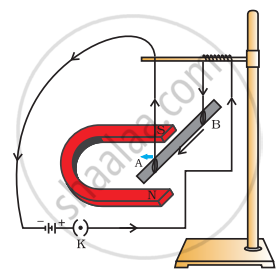
State giving reason:
- What is observed when a current is passed through the aluminium rod from end B to end A?
- What change is observed in a situation in which the axis of the rod 'AB' is moved and aligned parallel to the magnetic field and current is passed in the rod in the same direction?
