English

When the Switch S is Closed in the Figure Given Below, the Pointer of the Galvanometer Moves to the Right. - Science

Advertisements
Advertisements

Question

When the switch S is closed in the figure given below, the pointer of the galvanometer moves to the right.  
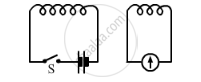
 

If S is kept closed, will the pointer:

(a) return to zero?
(b) stay over on the right?
(c) move to the left and stay there
(d) move to and fro until S is opened

Advertisements

Solution

return to zero
After some time, the magnetic field gets constant; this means that there is no relative change in the value of magnetic field. Therefore, the circuit will have zero induced current. 

shaalaa.com
  Is there an error in this question or solution?
Chapter 2: Magnetic Effects of Electric Current - Exercise 4 [Page 104]

APPEARS IN

Lakhmir Singh Physics (Science) [English] Class 10
Chapter 2 Magnetic Effects of Electric Current
Exercise 4 | Q 29 | Page 104

RELATED QUESTIONS

An electromagnet does not attract a piece of iron.


An electric bell has an electromagnet. 


Do you think an electromagnet can be used for separating plastic bags from a garbage heap? Explain.


Fill in the following blank with suitable words: 

The magnetic effect of a coil can be increased by increasing the number of ........... increasing the ........... or inserting an ........... core.


Describe some experiment to show that the magnetic field is associated with an electric current. 


For the coil in the diagram below, when the switch is pressed:

(a) what is the polarity of end A?
(b) which way will the compass point then?    


The north pole of a long bar magnet was pushed slowly into a short solenoid connected to a galvanometer. The magnet was held stationary for a few seconds with the north pole in the middle of the solenoid and then withdrawn rapidly. The maximum deflection of the galvanometer was observed when the magnet was ______.


How should the electric lamps in a building be connected so that the switching on or off in a room has no effect on other lamps in the same building?


In the Activity shown below, how do we think the displacement of rod AB will be affected if

  1. current in rod AB is increased
  2. a stronger horse-shoe magnet is used
  3. length of the rod AB is increased?
  • Take a small aluminium rod AB (of about 5 cm). Using two connecting wires suspend it horizontally from a stand, as shown in Fig.
  • Place a strong horse-shoe magnet in such a way that the rod lies between the two poles with the magnetic field directed upwards. For this put the north pole of the magnet vertically below and south pole vertically above the aluminium rod (Fig.).
  • Connect the aluminium rod in series with a battery, a key and a rheostat.
  • Now pass a current through the aluminium rod from end B to end A.
  • What do you observe? It is observed that the rod is displaced towards the left. You will notice that the rod gets displaced.
  • Reverse the direction of current flowing through the rod and observe the direction of its displacement. It is now towards the right.
  • Why does the rod get displaced?


A current-carrying rod, AB, experiences a force perpendicular to its length and the magnetic field. Support for the magnet is not shown here, for simplicity.


What is the function of a split ring in an electric motor?


When the resistance of a conductor increases, the current ____________ .

(b) State whether the following statements are true or false:

(i) Magnetic poles exist in pairs.

(ii) Global warming is a desirable aspect of the intensified greenhouse effect.


Draw a neat labelled diagram to show the magnetic effect of electric current.


Explain the magnetic field created around a straight current carrying conductor with the help of a diagram.


Why do we cover plug pin holes which are within the reach of children with cellotape or a plastic cover when not in use?


How does the magnetic effect of electric current help in the working of an electric bell? Explain with the help of a diagram.


A wire with green insulation is usually the live wire of an electric supply.


Make four electromagnets with 20, 40, 60 and 80 turns. Connect them one by one to a battery of 2 cells. Bring the electromagnet near a box of pins. Count the number of pins attracted by it. Compare the strengths of the electromagnets.


Share
Notifications

Englishहिंदीमराठी


      Forgot password?
Use app×